When social media becomes our history teacher
Today, I came across a post on Facebook accompanied by a particularly eye-catching historical image.
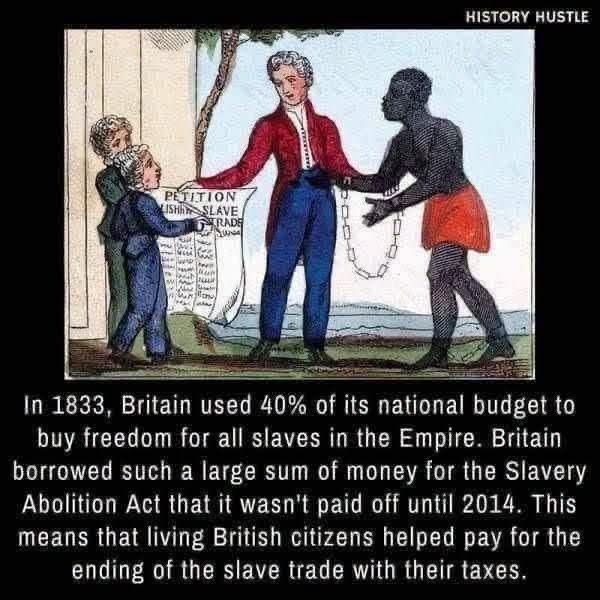
The image claimed that in 1833 Britain committed approximately 40% of its national budget to purchasing the freedom of enslaved people throughout the British Empire, borrowing such an enormous sum that British taxpayers were still paying for it until 2015.
The accompanying commentary was lengthy and passionate, discussing slavery, Britain’s historical achievements, reparations, white privilege, colonialism and the increasingly contentious expectation that present generations should apologise for the actions of their ancestors.
It certainly caught my attention.
Shortly afterwards, I encountered another Facebook post, this time sharing an opinion article published by the Daily Express.
The article was equally forthright, arguing that Britain should not pay reparations for historical slavery and questioning the morality, practicality and economic consequences of requiring contemporary taxpayers to compensate the descendants of people enslaved centuries earlier.
Interestingly, the author also discussed her Ghanaian heritage, including the historical involvement of the Fante people in the transatlantic slave trade.
These two posts approached the subject from somewhat different perspectives, but both raised similar questions about historical responsibility, national identity and inherited guilt.
Before examining their claims, however, I think it is important to establish something frequently overlooked when historical information is shared online.
Facebook is not recognised as a credible academic source in its own right.
It is a social media platform, not a peer-reviewed historical journal, academic institution or authoritative historical archive.
That does not automatically mean that information published on Facebook is incorrect. Social media can introduce people to important historical events, encourage discussion and make academic research more accessible to the general public.
However, there is a significant distinction that makes platforms such as Facebook particularly influential in shaping public understanding of history.
Social media has the potential to reach a considerably larger audience than traditional academic publications, historical research papers or scholarly journals.
An eye-catching image accompanied by a confident statement and strongly expressed opinion can be shared thousands of times, potentially reaching hundreds of thousands or even millions of people within a remarkably short period.
By comparison, a carefully researched academic paper, supported by primary historical documents, contemporary records and scholarly scrutiny, may attract only a relatively small readership.
This creates an interesting, and potentially troubling, imbalance.
The information receiving the greatest public exposure is not necessarily the information subjected to the greatest scrutiny.
Social media algorithms can amplify content because it attracts attention, provokes emotional reactions or encourages discussion, rather than because it is historically accurate.
Consequently, a misleading historical claim can become widely accepted through repetition, particularly when it reinforces an opinion that readers already hold.
Once such claims become established within public discussion, correcting them can prove considerably more difficult than spreading them in the first place.
Popularity is not evidence. Repetition is not verification. And the confidence with which an opinion is expressed does not establish historical accuracy.
The Daily Express presents a slightly different issue.
Unlike an unattributed Facebook image, a newspaper opinion column has an identifiable publisher and may be subject to editorial processes. However, it remains an opinion column, not an independently peer-reviewed historical study.
The distinction between journalism, commentary and academic evidence is important.
The original Facebook post contains a considerable amount of genuine historical information. Slavery existed long before the Atlantic trade, Britain made an extraordinary contribution to international abolition, and the suffering of Britain’s own working classes is frequently overlooked in discussions of historical privilege.
The Daily Express article introduces further legitimate considerations about African participation in the slave trade, the Commonwealth and the extraordinary financial sums proposed in some reparations calculations.
But both also contain interpretations, generalisations and political conclusions that require closer examination.
I have previously written about slavery, colonialism and the contentious subject of reparations.
My position remains that historical responsibility does not automatically create inherited personal guilt, nor does historical injustice automatically establish an entitlement to financial compensation from people who had no personal involvement in it.
However, if we are going to challenge selective presentations of history, we must be equally prepared to examine the accuracy of arguments that support our own position.
Historical facts should not become less important simply because they undermine an argument with which we happen to agree.
Slavery was not invented by Britain
One of the central arguments in both posts is that slavery existed throughout human history, long before Britain became involved in the Atlantic slave trade.
This is demonstrably true.
Slavery was practised by the ancient Egyptians, Greeks and Romans, throughout parts of Africa, the Middle East and Asia, and within Europe itself.
Enslavement occurred through warfare, raids, conquest, hereditary status, debt and criminal punishment.
The Domesday Book of 1086, commissioned by William the Conqueror, records enslaved people in England centuries before the Atlantic trade developed.
The Romans enslaved conquered populations throughout their empire, including people from Britain and other European territories.
Arab and trans-Saharan slave-trading networks operated for centuries before European powers developed the transatlantic system.
African kingdoms, merchants and political leaders also participated in slavery, including the capture, ownership and sale of enslaved people.
European populations were themselves subjected to enslavement at different periods, including through Mediterranean raids and systems of forced servitude.
The Ottoman Empire maintained extensive systems of slavery over several centuries.
These are important historical facts.
Slavery was not a uniquely British, European or white institution.
However, acknowledging this does not absolve Britain of its subsequent involvement.
Britain became one of the largest participants in the Atlantic slave trade.
Between the seventeenth century and the abolition of British participation in 1807, British vessels transported approximately 3.1 million enslaved Africans.
Hundreds of thousands died during the Atlantic crossing.
Wealth generated through slavery contributed to British commercial interests, colonial development and sections of the wider economy.
The existence of slavery elsewhere does not excuse Britain’s participation, just as Britain’s involvement does not excuse the actions of other civilisations.
Historical responsibility cannot reasonably operate in only one direction.
If slavery was morally wrong, it was wrong whether practised by a British merchant, an African ruler, an Arab trader, a Roman citizen or an Ottoman official.
The nationality or ethnicity of the perpetrator does not alter the fundamental injustice.
African participation in the slave trade: an uncomfortable historical reality
The Daily Express article introduces an important perspective through its author’s discussion of her Ghanaian heritage.
She identifies herself as a woman of Fante ancestry and describes the historical involvement of members of that society in the transatlantic slave trade.
This is significant because the relationship between African societies and European slave traders is frequently oversimplified.
The transatlantic trade was not conducted exclusively through Europeans entering Africa and independently capturing millions of people.
In many regions, European traders purchased enslaved people from African merchants, rulers and intermediaries.
Captives might have been obtained through warfare, raids, punishment, kidnapping or established systems of enslavement.
Some African political and commercial elites accumulated considerable wealth and power through participation in the trade.
The Fante, based in what is now Ghana, became influential commercial intermediaries along the Gold Coast.
The Asante Empire also developed extensive networks involving warfare, captives and slave trading.
Historical research confirms that these relationships were commercially and politically significant.
For example, the eighteenth-century records of British trader Richard Miles document more than 1,300 exchanges involving enslaved people on the Gold Coast between 1772 and 1780, including transactions with Fante intermediaries.
Such evidence challenges any account portraying African populations solely as passive participants in the development of the Atlantic system.
However, it would be equally misleading to imply that all African societies benefited equally, or that those supplying captives represented the interests of the millions of people who suffered enslavement.
Africa was not a single political entity.
It contained numerous kingdoms, societies, ethnic groups and competing commercial interests.
Some participated in slave trading. Others were devastated by it. Some opposed enslavement, and African abolitionist movements also emerged.
Indeed, historical scholarship identifies anti-slavery activity among Fante communities during the nineteenth century.
There is also an important distinction between African participation in the capture and sale of enslaved people and European responsibility for establishing and sustaining the enormous plantation economies across the Americas.
The European demand for enslaved labour helped create and expand the economic incentives underpinning the transatlantic trade.
Both sides of this commercial relationship must be examined.
Acknowledging African participation does not diminish European responsibility. Equally, recognising European responsibility should not require us to erase African participation.
This is precisely why historical discussion becomes unproductive when conducted through simplistic categories of collective guilt.
Britain’s extraordinary contribution to abolition
Where I strongly agree with both posts is that Britain’s subsequent contribution to the abolition and international suppression of slavery deserves considerably more recognition.
The Slave Trade Act 1807 prohibited British participation in the slave trade.
The Slavery Abolition Act 1833 subsequently provided for the abolition of slavery across most of the British Empire, with emancipation beginning in 1834.
Many formerly enslaved people nevertheless remained subject to compulsory apprenticeship until 1838.
These changes represented an enormous political and economic transformation.
Britain subsequently committed considerable naval, diplomatic and financial resources to suppressing the international slave trade.
The Royal Navy’s West Africa Squadron operated for decades along the African coast, intercepting slave ships and enforcing agreements intended to prevent the continued transportation of enslaved people.
Between 1808 and 1860, approximately 1,600 slave ships were captured and around 150,000 enslaved Africans liberated.
The human cost to British sailors was considerable.
Tropical diseases, particularly malaria and yellow fever, presented enormous dangers in an era before effective prevention and treatment.
The original Facebook post cites 17,000 sailors losing their lives.
That figure has appeared in Royal Navy accounts, although other historical assessments suggest substantially lower totals. The precise number remains disputed.
Nevertheless, the operational dangers and human sacrifices associated with the campaign are beyond doubt.
Britain devoted considerable resources to suppressing an international trade from which it had previously profited.
That is an extraordinary historical achievement, and one of which Britain can legitimately be proud.
However, Britain was not the first country to prohibit slave trading or abolish slavery.
Nor did it possess the authority to prohibit slavery universally.
We should not need to exaggerate our achievements to appreciate their significance.
There is also an important point about the abolitionist movement itself.
Britain did not unanimously decide that slavery was wrong.
Abolition followed decades of campaigning, political confrontation and public mobilisation.
Individuals such as William Wilberforce, Thomas Clarkson and Olaudah Equiano played important roles, alongside countless campaigners, formerly enslaved people and those resisting slavery directly.
The abolition movement was, in substantial part, a campaign by people within British society to change the laws and practices of their own country.
This deserves recognition.
The £20 million abolition settlement: an extraordinary financial commitment
The original Facebook image claimed that Britain committed approximately 40% of its national budget to securing the abolition of slavery.
This is substantially correct, although the description of what the money purchased requires considerable qualification.
Under the 1833 abolition legislation, Parliament authorised £20 million in compensation for slave owners.
At the time, annual government expenditure was approximately £48.8 million.
The compensation therefore represented around 40% of one year’s government expenditure.
That was an extraordinary financial commitment.
But the economic significance of £20 million in 1833 is considerably greater than simply reading the same figure in 2026.
Over almost two centuries, inflation, economic expansion, changes in wages, productivity and purchasing power have fundamentally altered the significance of money.
Using a consumer-price inflation comparison, £20 million in 1833 equates to approximately £3.1 billion in 2026 purchasing power.
However, inflation is only one method of comparison.
When historical expenditure is compared with average earnings, national income or the relative size of the economy, the equivalent economic significance becomes considerably greater.
Historical comparisons have placed the amount at approximately £17 billion when measured against changes in earnings, and above £100 billion when measured against the economy’s relative size.
Those larger estimates were calculated using earlier modern reference years, so they should not be mistaken for precise 2026 valuations.
What they demonstrate is that a purely inflation-based calculation can substantially understate the economic scale of the decision.
Perhaps the clearest comparison remains the original 40% of annual government expenditure.
Imagine a modern government allocating an amount approaching two-fifths of its annual expenditure to one financial settlement.
That provides a better appreciation of the financial significance of the commitment.
However, we must acknowledge another fundamental historical fact.
The £20 million was paid to slave owners, not to the people who had been enslaved.
The settlement compensated individuals and institutions for the loss of what British law had previously recognised as their property.
Those who had actually endured enslavement received no financial compensation.
Furthermore, many were compelled to continue working without wages under the apprenticeship system until 1838.
This creates an uncomfortable historical contradiction.
Britain committed enormous financial resources to abolishing slavery, yet the direct financial beneficiaries were those who had owned enslaved people.
Some might argue that compensation was the political compromise necessary to obtain parliamentary agreement for abolition.
Others would question the morality of compensating people for losing the ability to own another human being.
Both the political circumstances and the ethical implications deserve examination.
The compensation was financed substantially through government borrowing, including the West India Slave Compensation Loan of 1835.
This borrowing was subsequently incorporated into the wider national debt.
The remaining relevant undated government bonds were finally redeemed in 2015.
There is therefore a factual basis for observing that British taxpayers continued servicing government borrowing historically associated with slave-owner compensation.
However, it is misleading to suggest that a distinct £20 million abolition loan simply remained unpaid for 180 years.
The lengthy period resulted from the structure of the government bonds and the date on which they were eventually redeemed.
There is also a fundamental distinction between the abolition of British participation in the slave trade in 1807 and the compensation settlement associated with abolishing slavery in the 1830s.
They were different measures.
We should recognise both the extraordinary scale of Britain’s financial commitment and the uncomfortable reality that the money compensated slave owners rather than those they had enslaved.
Neither historical fact should be omitted simply because it complicates a particular political argument.
£18.8 trillion in reparations: a debt or an economic calculation?
The Daily Express article introduces another striking financial figure.
It refers to an estimate placing Britain’s potential slavery reparations liability at approximately £18.8 trillion.
This is not a figure invented by social media.
It is broadly consistent with the findings of a 2023 economic study prepared by The Brattle Group, which calculated approximately £18.6 trillion in reparations attributable to Britain’s involvement in transatlantic slavery.
The wider study estimated reparations across responsible countries at approximately US$100 trillion to US$131 trillion, depending upon the economic measures applied.
These calculations attempted to place financial values upon historical harms, including uncompensated labour, loss of liberty and continuing consequences of enslavement.
This is an important distinction.
An economic estimate of historical harm is not the same as an established legal debt.
Nor does the publication of such a figure automatically mean that Britain has a legal obligation to pay it, that the government has accepted the calculation, or that a practicable mechanism exists to distribute such an enormous sum.
To put the figure into perspective, £18.6 trillion represents several years of Britain’s entire annual economic output.
It is also substantially greater than annual government expenditure.
Such a demand would therefore raise profound questions about public finances, taxation, borrowing, economic stability and the allocation of national resources.
The practical implications cannot simply be dismissed.
But neither can the underlying research be rejected solely because the resulting sum is extraordinarily large.
A serious examination must consider how the figure was calculated, the assumptions used, the legal arguments presented and the feasibility of the proposed remedy.
The distinction between historical harm and present-day financial liability is crucial.
The transatlantic slave trade caused immense human suffering.
That historical reality is not diminished by questioning whether a particular financial calculation creates a legitimate debt owed by modern taxpayers.
Equally, disputing an economic estimate does not establish that no continuing harm exists.
Those are separate questions.
My concern is not that the suffering of enslaved populations should be ignored.
It is that the existence of historical wrongdoing does not automatically establish who should pay, who should receive compensation, how liability should be calculated or whether the proposed remedy would itself be equitable.
These are precisely the questions that any credible reparations proposal must answer.
The forgotten suffering of Britain’s working classes
Another argument raised in the original Facebook post deserves serious consideration.
The conditions endured by Britain’s working classes during the eighteenth and nineteenth centuries were frequently appalling.
Industrialisation generated enormous economic development, but the benefits were distributed very unevenly.
Men, women and children worked in mines, mills, factories and agricultural employment under conditions that would be regarded as intolerable today.
Child labour was widespread.
Industrial accidents, occupational disease, malnutrition, inadequate sanitation and overcrowded housing were everyday realities.
Entire families could occupy single rooms in damp, poorly ventilated accommodation, sharing rudimentary sanitation facilities with numerous other households.
The criminal justice system could also be extraordinarily severe.
Imprisonment, transportation and, for some offences and periods, capital punishment were part of the legal framework.
Life expectancy was substantially lower than today, although the frequently quoted figure of 35 years requires qualification because exceptionally high infant and childhood mortality reduced historical averages.
It did not mean that an adult reaching 35 was necessarily approaching the end of their life.
Nevertheless, there should be no romanticisation of working-class existence during Britain’s imperial and industrial expansion.
Large sections of the population endured desperate poverty, insecurity and exploitation.
This is why discussions of historical white privilege require considerably more nuance than they sometimes receive.
To suggest that every white person throughout history enjoyed a privileged existence simply because of their skin colour is an extraordinary oversimplification.
However, poverty and racial disadvantage are not mutually exclusive.
A poor white industrial worker could endure terrible hardship while an enslaved African was simultaneously denied personal freedom and legal autonomy.
Recognising one form of suffering does not invalidate another.
Race, class, wealth, sex and social position could all influence the opportunities available to an individual.
It is therefore unreasonable to suggest that white poverty proves racial discrimination never conferred advantages.
It is equally unreasonable to suggest that historical racial discrimination means every white individual enjoyed a privileged life.
We cannot determine an individual’s difficulties, achievements, opportunities or moral character simply by looking at their skin colour.
That should be a straightforward principle of equality.
White privilege, discrimination and positive action
The original Facebook post goes further, suggesting that white males can legally be subjected to racial abuse or discriminatory treatment in circumstances where other groups cannot.
That is not an accurate representation of British law.
The Equality Act 2010 protects individuals against unlawful discrimination on grounds including race and sex.
Those protections apply to white men just as they apply to everyone else.
There is also an important distinction between lawful positive action and unlawful positive discrimination.
Positive action may be permitted where proportionate measures address evidenced disadvantage or underrepresentation.
Positive discrimination that falls outside the statutory provisions is generally unlawful, subject to specific legal exceptions.
Whether particular diversity initiatives are fair, proportionate or effective is an entirely legitimate subject for debate.
However, that debate should be based upon what the law actually permits.
The broader social concern remains worth examining.
If we genuinely believe in equality, then individuals should be judged according to their own conduct, abilities and circumstances rather than assumptions attached to their race or sex.
The language of privilege may have a role in examining wider social patterns, but it becomes less useful when applied as a blanket judgement about an individual.
A person’s skin colour cannot, by itself, tell us whether they experienced poverty, discrimination, hardship or disadvantage.
Nor can it determine whether they are morally responsible for events that occurred centuries before they were born.
The Commonwealth: a colonial relic or a voluntary association?
The Daily Express article also highlights the continuing existence and expansion of the Commonwealth.
This is an important point.
As of October 2026, the Commonwealth consists of 56 independent member countries with a combined population of approximately 2.7 billion people.
Its membership extends across Africa, Asia, the Caribbean, Europe and the Pacific.
Significantly, not every member country was formerly part of the British Empire.
Mozambique, Rwanda, Gabon and Togo are examples of countries that joined despite not having been British colonies.
This demonstrates that membership is not exclusively determined by Britain’s colonial history.
The modern Commonwealth is a voluntary association of independent nations that cooperate on matters including governance, education, economic development, trade and international relations.
Many members are republics.
King Charles III serves as Head of the Commonwealth, a symbolic position distinct from his constitutional role as monarch of those countries that retain him as their head of state.
Republican Commonwealth members do not thereby accept the King as their national monarch.
The fact that countries have chosen to remain members, and that others have subsequently joined, demonstrates that the organisation continues to offer perceived value beyond its historical origins.
However, Commonwealth membership should not be interpreted as universal approval of Britain’s imperial history.
Nor does continued membership necessarily mean that a country has abandoned claims relating to colonialism, slavery or reparations.
Countries can recognise the practical benefits of international cooperation while maintaining legitimate disagreements about historical events.
The existence of those disagreements does not automatically undermine the Commonwealth.
Indeed, an organisation intended to bring independent nations together should be capable of accommodating difficult conversations about their shared history.
King Charles III and the politics of reparations
The timing of the Daily Express article is particularly relevant.
King Charles III is undertaking a Caribbean tour from 27 October to 4 November 2026.
His itinerary includes the Bahamas, Guyana and Antigua and Barbuda.
The visit coincides with the Commonwealth Heads of Government Meeting, scheduled to take place in Antigua and Barbuda from 1 to 4 November.
The issue of slavery reparations has become an increasingly prominent subject within discussions involving Caribbean governments, Britain and the wider Commonwealth.
The Daily Express author argues that the King should not be expected to apologise for historical events in which he played no personal part.
There is an important distinction here.
King Charles III was not personally responsible for Britain’s involvement in the slave trade.
Neither were the millions of British citizens alive today.
However, the monarchy is an institution with historical continuity extending across the period of Britain’s participation in slavery and colonial expansion.
Consequently, some campaigners argue that institutional acknowledgement or apology is appropriate regardless of the personal innocence of the current monarch.
Others argue that such apologies risk implying an inherited moral responsibility that cannot fairly be assigned to individuals living today.
These are different interpretations of institutional responsibility.
The British government’s present position is that it does not support financial reparations for historical slavery.
But the Daily Express assertion that Britain will never pay reparations is a prediction and political position, not an established historical fact.
Future governments may adopt different policies.
Equally, a refusal to make financial payments does not prevent governments, institutions or monarchs from acknowledging historical suffering.
There is no logical requirement that historical acknowledgement, a formal apology and financial reparations must always be treated as one indivisible question.
Reparations: responsibility or inherited guilt?
This brings us to the central issue.
My objection is not to studying slavery, acknowledging historical wrongdoing or recognising the suffering endured by those who were enslaved.
Those are legitimate and necessary aspects of understanding history.
My concern is the suggestion that historical wrongdoing automatically creates a personal moral or financial obligation for people living generations later.
Personal guilt is not hereditary.
Someone born in Britain in 1970, 1990 or 2020 cannot reasonably be held personally responsible for decisions made by a British slave trader in 1750.
Equally, an individual living today cannot automatically claim to have personally experienced an injustice simply because someone sharing their ancestry suffered it centuries earlier.
However, the consequences of historical wrongdoing do not necessarily disappear when those directly involved die.
Governments, institutions and economic arrangements can continue across generations.
Some historical injustices may also produce consequences that remain measurable in the present.
Those questions deserve examination rather than dismissal.
Nevertheless, any credible claim for reparations should satisfy several fundamental principles.
There must be an identifiable wrong, a justified basis for assigning responsibility, legitimate claimants, evidence connecting the historical harm with the proposed remedy, and serious consideration of proportionality and fairness.
We should also distinguish between compensation for identifiable surviving victims, institutional responsibility for continuing harm and generalised financial demands against entire populations.
The beneficiaries of slavery and imperial wealth were not distributed equally throughout British society.
An impoverished agricultural labourer or factory worker did not necessarily benefit from colonial wealth in anything approaching the same way as a plantation owner, merchant or wealthy investor.
Similarly, the descendants of enslaved people do not all occupy identical economic or social circumstances today.
A reparations system that assumes uniform responsibility and uniform entitlement solely on the basis of ancestry would therefore raise substantial questions of fairness.
A remedy for yesterday’s injustice should not automatically become today’s injustice.
There are other constructive ways of addressing historical wrongdoing.
Education, preservation of historical records, institutional accountability, acknowledgement and carefully evidenced measures addressing continuing disadvantage all deserve consideration.
Financial reparations may also be argued for in particular circumstances, but their justification should be demonstrated rather than presumed.
What I reject is the principle that guilt or entitlement should automatically be assigned to individuals according to their skin colour, nationality or distant ancestry.
Should Britain apologise, and should other nations thank us?
The original Facebook post asks an interesting question.
If contemporary British people are expected to apologise for historical wrongdoing, should other nations also be expected to express gratitude for Britain’s historical achievements?
The abolition of slavery, suppression of the international slave trade, scientific innovation, industrial development and Britain’s contribution to defeating Nazi Germany are all important elements of our national history.
However, there is a contradiction in the underlying argument.
If I cannot reasonably be held personally guilty for the actions of a British slave trader in 1750, why should I expect personal gratitude for the achievements of a Royal Navy officer in 1850?
We can acknowledge, commemorate and celebrate the achievements of previous generations without pretending that we personally accomplished them.
Equally, other nations can recognise Britain’s historical contributions without surrendering their right to examine the less admirable aspects of our shared history.
Historical pride and historical honesty are not mutually exclusive.
Britain’s contribution to defeating Napoleon, Imperial Germany and Nazi Germany is entirely legitimate grounds for recognition.
But those victories were achieved through international alliances.
And Britain certainly did not defeat Stalin militarily.
The Soviet Union was a major Allied power during the Second World War, even though it subsequently became Britain’s principal geopolitical adversary during the Cold War.
Accuracy matters even when discussing achievements of which we are rightly proud.
The same applies to Barbados.
Barbados became a republic on 30 November 2021, but had been independent since 1966.
Its decision to replace the British monarch as head of state was a sovereign constitutional choice, not simply a consequence of Black Lives Matter protests or an expression of ingratitude for British assistance.
Barbados also remained a Commonwealth member.
We cannot reasonably advocate national freedom and self-determination while criticising another independent country merely for exercising those principles.
History should teach us about power, not inherited hatred
One of the more interesting arguments in the Daily Express article concerns the purpose of studying history.
The author suggests that history should help us understand why human beings abuse power, why societies tolerate practices subsequently regarded as abhorrent, and why individuals are frequently less morally independent of their own historical circumstances than they imagine.
I think there is considerable value in that observation.
It is very easy to examine the past through contemporary moral standards and assume that, had we lived centuries earlier, we would automatically have been among the enlightened minority opposing injustice.
But human behaviour is influenced by social expectations, economic circumstances, education, political authority and cultural norms.
That does not excuse historical wrongdoing.
It does, however, encourage a more serious examination of how such wrongdoing became normalised.
The institution of slavery was maintained not simply by individuals who enjoyed cruelty, but through political systems, commercial interests, laws, social hierarchies and widespread acceptance of practices that many people today find abhorrent.
Understanding these mechanisms may be more valuable than simply declaring that previous generations were morally inferior.
It also encourages us to examine contemporary society.
Which practices do we accept today that future generations may regard as intolerable?
Which injustices do we overlook because they benefit our economic interests?
And how willing are we to challenge wrongdoing when doing so might require personal sacrifice?
These are uncomfortable questions.
But they are precisely the questions that history should encourage us to ask.
History is not a competition in suffering
Perhaps the most concerning aspect of contemporary discussions surrounding slavery, reparations and historical identity is the tendency to divide populations into categories of inherited guilt and inherited victimhood.
This risks reducing the complexity of human history to a simplistic distinction between oppressors and oppressed.
History rarely operates in such convenient categories.
Nations that were once conquered subsequently became conquerors.
Populations that experienced enslavement sometimes participated in enslaving others.
Societies that profited from exploitative practices later became instrumental in dismantling them.
Britain itself demonstrates these contradictions.
We participated in the Atlantic slave trade.
Sections of our economy benefited from colonial slavery.
And Britain subsequently became one of the leading international forces in suppressing the trade.
All three realities form part of the historical record.
None should be erased in order to emphasise another.
The same principle applies to African societies involved in the slave trade, the history of European enslavement, the Ottoman Empire and the suffering of Britain’s working classes.
These experiences were not identical, but all deserve to be understood.
Human suffering should not become a competition in which recognising one group’s experiences somehow invalidates another’s.
Nor should the complexity of history be reduced to an assumption that entire contemporary populations share collective guilt or collective virtue.
Conclusion: understanding history without inheriting guilt
I understand much of the frustration expressed in the original Facebook post.
I also understand the concerns raised by the Daily Express opinion article about the potentially enormous financial implications of reparations and the moral difficulties associated with assigning liability to people who had no involvement in historical slavery.
Britain’s contribution to abolishing and suppressing the international slave trade deserves considerable recognition.
So too does the frequently overlooked suffering of Britain’s working classes.
And the historical participation of African societies, Arab traders and other civilisations in slavery should not be ignored because it complicates familiar narratives.
However, recognising those facts does not require us to deny Britain’s involvement in slavery, exaggerate our achievements or dismiss the suffering of others.
The same standards of historical accuracy must apply to everyone.
Britain has an extraordinary history containing immense political, scientific, industrial, cultural and humanitarian achievements.
It also contains conquest, exploitation, inequality and participation in slavery.
Both deserve to be understood.
The £20 million abolition compensation settlement illustrates this perfectly.
It represented an extraordinary financial commitment, approximately 40% of annual government expenditure, with an economic significance vastly greater than the nominal figure suggests today.
Yet the compensation was paid to slave owners rather than the people they had enslaved.
Both facts are historically important.
Similarly, the £18.6 trillion reparations estimate highlights the enormous economic value that some researchers attribute to the historical harms of slavery.
But an economic estimate is not automatically an enforceable debt, nor does it resolve the difficult questions of who should pay, who should receive compensation and how a just settlement could be achieved.
Those distinctions matter.
The same principle applies to the Commonwealth.
Its continued existence and voluntary membership demonstrate that former colonies and other independent nations can find value in international cooperation.
But membership should not be mistaken for unanimous approval of Britain’s imperial past.
The two Facebook posts that prompted this article contain important historical observations and legitimate questions.
They also illustrate why it is essential to distinguish evidence from interpretation and political conviction from historical fact.
Historical responsibility is not the same as inherited personal guilt.
Historical suffering does not automatically establish inherited entitlement.
Historical achievement does not automatically entitle descendants to personal gratitude.
And perhaps most importantly:
History is not a hereditary balance sheet of collective guilt and collective virtue.
We should inherit a responsibility to understand history, not automatically the guilt of those who lived it.
Nor should anyone be required to spend their life apologising for actions they never committed, any more than they should expect personal gratitude for achievements in which they played no part.
The purpose of studying history should be to understand how societies functioned, why injustices occurred, how they were challenged and what lessons can be applied to the world in which we live today.
It should encourage intellectual curiosity rather than inherited resentment.
It should promote historical understanding rather than competition over victimhood.
And it should allow us to acknowledge both the achievements and wrongdoing of previous generations without treating either as a personal moral inheritance.
We are responsible for our own conduct, our own decisions and the society we choose to create today.
Surely that provides a more constructive foundation for equality than endlessly assigning guilt, virtue and victimhood according to ancestry.

