The Bishorn, First-Hand Experience and the Changing Reality of Alpine Mountaineering
First-hand expedition account: Peter Elliott and Costas Malas
Bishorn, Swiss Alps — August 2026
The traditional Alpine grading system remains one of mountaineering’s most useful tools.
A route graded F, PD, AD or D immediately gives an experienced climber an indication of the technical difficulties likely to be encountered. Combined with distance, height gain, guidebook time, weather and local knowledge, it helps determine whether an objective lies within a climber’s capabilities.
But the conditions experienced across the European Alps during the summer of 2026 expose an increasingly important limitation.
The grade describes the route. It does not necessarily describe the mountain as it exists today.
High temperatures, inadequate overnight freezing, diminishing seasonal snow cover, exposed glacier ice, opening crevasses and changing bergschrunds can substantially alter the character and seriousness of a route without changing the letters printed beside its name in a guidebook.
The Bishorn provides an interesting example. The Swiss Alpine Club describes its normal route from the Cabane de Tracuit as a relatively easy and rewarding way of climbing a 4,000-metre peak, while specifically warning of potentially large crevasses. The SAC currently gives the normal summer route an F grade, with approximately 895m of ascent from Tracuit.
Yet a successful ascent by Peter Elliott and Costas Malas in August 2026 tells us something the guidebook cannot.
It tells us what the mountain actually felt like to climb.
Peter Elliott and Costas Malas on the Bishorn
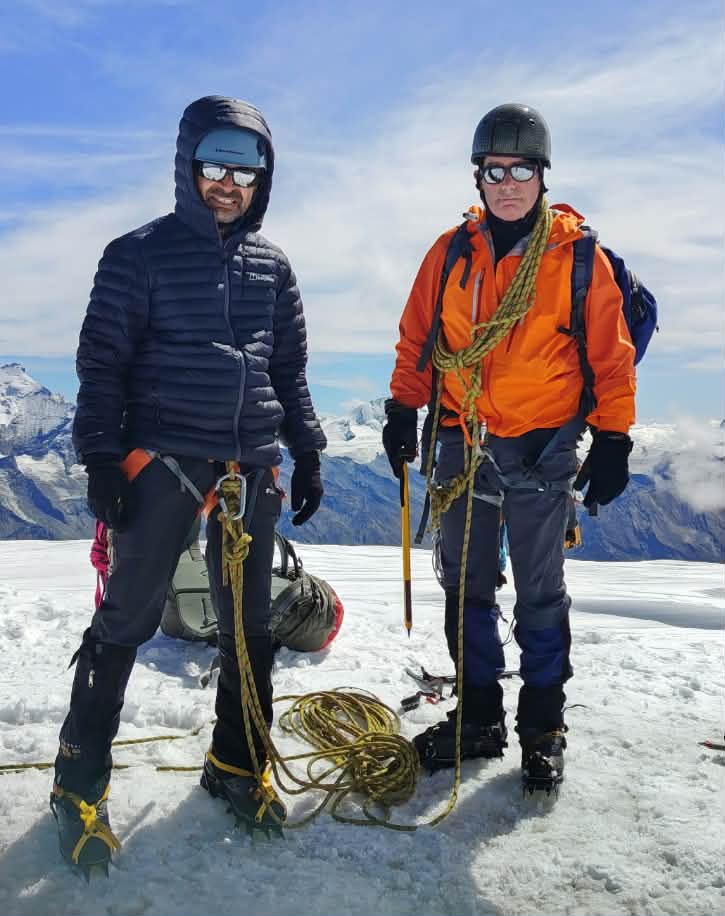
Peter Elliott (right, orange) and Costas Malas (left) during their successful ascent of the Bishorn, August 2026. Their first-hand observations provide a contemporary account of the physical, psychological and objective challenges encountered on the mountain.
Photograph courtesy of Peter Elliott and Costas Malas.
The 2,500-Metre Vertical Debt
Elliott and Malas begin their account with the fundamental problem:
“The Setup: The 2,500-Meter Vertical Debt”
“From the valley floor (1,675m) to the summit (4,153m), you owe 2,500 meters (8,200 ft) of pure upward grind. There are no flat sections, no traverses to catch your breath—just a continuous, unforgiving tilt that never, ever gives you a break.”
Before considering crevasses, crampons, snow conditions or technical climbing, the Bishorn therefore presents a substantial physiological problem.
From Zinal to the summit, the total height gain is approximately 2,480 metres. The first day alone involves around 1,600 metres of ascent to reach the Cabane de Tracuit at 3,256m.
On paper, this is the approach.
Physiologically, it is already a major mountain day.
Day One: “Leg Bankruptcy”
Elliott and Malas describe it rather less clinically:
“Phase 1: The Hut Approach (Day 1) – The ‘Leg Bankruptcy’”
“You strap on a heavy overnight pack and immediately tackle a 1,600m stairmaster from hell. The final hour funnels into a steep, rocky gully where you’re hauling your own bodyweight up fixed steel chains and rungs—high-steps, pull-ups, and shaky quad-burning lunges.”
The colourful description identifies something conventional grading systems struggle to express:
accumulated fatigue.
Reaching the hut does not reset the physiological clock.
The legs required to climb the Bishorn tomorrow are the same legs that have just climbed approximately 1,600 metres today.
And there is another factor.
Altitude.
Their account continues:
“You stagger into the Tracuit Hut at 3,256m with shredded thighs and exhausted forearms, but instead of recovering, you lie awake at altitude, your heart pounding at 90 BPM while your muscles get zero repair.”
Sleep above 3,000 metres can be disturbed, particularly when acclimatisation is incomplete. Increased ventilation and cardiovascular activity can combine with fragmented sleep to compromise recovery following an already strenuous day.
The mountaineer therefore does not necessarily begin summit day recovered.
They may begin it carrying a considerable fatigue debt.
And the mountain is about to collect the next instalment.
Day Two: The “Slog of Despair”
The normal route leaves Tracuit and crosses the Turtmann Glacier before climbing progressively towards the summit.
Under normal conditions, the SAC describes this as predominantly straightforward glacier terrain. But it also specifically warns of large crevasses and notes that the established track should never simply be followed blindly.
Elliott and Malas encountered something rather more complicated:
“Phase 2: The Glacier Grind (Day 2, 3,300m–4,000m) – The ‘Slog of Despair’”
“Summit day starts on dead legs. The glacier spits you straight into a massive, weaving crevasse field, forcing constant detours, awkward step-overs, and post-holing through soft snow that cramps your calves with every shift.”
Their observations are particularly interesting when compared with reports from earlier in August. A conditions report from 6 August described exposed ice on the lower Bishorn, visible crevasses and notably poor overnight freezing, with snow sufficiently soft that leaving the established track was difficult.
This is where apparently small changes in Alpine conditions can accumulate into something much more significant.
A crevasse does not have to become technically difficult to make a route considerably harder.
It simply has to alter movement.
A straight glacier track becomes a weaving one. Continuous walking becomes repeated stops and changes of direction. A predictable stride becomes an awkward step-over. Firm snow becomes intermittent post-holing.
Individually, each may appear trivial.
Repeated over several hours at altitude, they are not.
Altitude Magnifies Everything
Elliott and Malas describe the increasing physiological burden:
“By 3,800m, the oxygen is down ~40%. That remaining 900m push feels like 1,500m at sea level—but you have no reserves left.”
There is an important technical distinction here.
The percentage of oxygen in the atmosphere remains approximately 21%. What decreases with altitude is atmospheric pressure and therefore the partial pressure of inspired oxygen.
But the physiological experience they describe is entirely recognisable.
As altitude increases, maintaining a given workload becomes progressively more demanding.
The climber is simultaneously dealing with the previous day’s ascent, limited recovery, crampon movement, crevasse negotiation and continuing height gain.
Elliott and Malas describe the result:
“Every step is a bargain with your screaming quads, and the glacier just keeps tilting upward without a single flat inch to drop your heart rate.”
This distinction matters.
Technical difficulty and physiological difficulty are not interchangeable.
Neither is adequately represented by the other.
“There Is Just Too Much of Everything”
Then came a moment that perhaps captures the entire expedition better than any grading system could.
As Elliott and Malas approached the final summit push, Costas looked at what remained ahead and offered his assessment:
“This is bullshit… There is just too much of everything!”
— Costas Malas, Bishorn, August 2026
It is wonderfully unscientific.
It is also remarkably perceptive.
The problem was not necessarily that any single obstacle was beyond their technical ability.
It was that everything was arriving together.
Altitude was manageable.
Fatigue was manageable.
Crevasses were manageable.
Snow conditions were manageable.
Gradient was manageable.
Exposure was manageable.
But mountaineering risk is not always created by one overwhelming problem.
Sometimes it is created by the accumulation of numerous individually manageable problems.
By this point, Elliott and Malas had already climbed approximately 1,600 metres to Tracuit, attempted to recover above 3,200 metres, returned to climbing in the early hours, negotiated the glacier and continued towards 4,000 metres.
Fatigue was accumulating.
Concentration had been prolonged.
The margin for careless movement was diminishing.
And the mountain was not finished with them.
Malas’s wonderfully succinct observation therefore describes a genuine mountaineering phenomenon:
cumulative workload and cumulative risk.
Fatigue affects movement.
Altitude magnifies fatigue.
Poor snow increases energy expenditure.
Crevasses disrupt rhythm and demand concentration.
Exposure increases the consequence of error.
Prolonged concentration itself produces further fatigue.
Eventually, the climber is no longer dealing with a collection of independent problems.
They are dealing with a system in which each problem begins to amplify the others.
And that was when Elliott and Malas reached the most consequential terrain of their ascent.
The “Knife-Twist”
Their account describes the final phase:
“Phase 3: The Summit Execution (4,000m–4,153m) – The ‘Knife-Twist’”
“Just when your tank is past ‘E’, you hit the crux: a steep, exposed snow-and-ice pitch at 40°–45°, hovering directly above a yawning Bergschrund.”
This is where the distinction between difficulty and seriousness becomes particularly important.
The precise configuration of a bergschrund can change considerably through an Alpine season. Snow accumulation, melting, glacier movement, wind and temperature can transform the same section of mountain over remarkably short periods.
On this particular ascent, Elliott and Malas describe terrain demanding considerably greater concentration:
“This is a genuine no-fall zone—a slip means sliding past that gaping crevasse.”
The individual climbing movements need not necessarily be technically extreme.
But technical difficulty cannot be considered independently of consequence.
Nor can consequence be considered independently of fatigue.
Their account continues:
“But your legs are cooked, and now you must front-point (toe-first crampon strikes) and swing ice tools, demanding fresh upper-body power that left the building 3 hours ago.”
The physical demand has changed.
The climber who has spent hours predominantly walking uphill must now produce precise crampon placements and controlled tool movements.
And this happens at precisely the point at which physiological reserves are lowest.
Elliott and Malas identify the paradox perfectly:
“The hardest, most dangerous move arrives exactly when your body and mind are at their absolute weakest.”
That observation extends far beyond the Bishorn.
It describes one of the fundamental differences between climbing difficulty and mountaineering seriousness.
“Easy” Does Not Mean Safe
There is an interesting discrepancy worth acknowledging here.
Elliott and Malas refer to the climb as PD+, reflecting their assessment of what they encountered. The Swiss Alpine Club’s current summer normal-route description, however, grades the NW flank from Tracuit F, while still warning about crevasse danger. Other route descriptions have used F/F+ or different grading conventions.
Rather than undermining the argument, this illustrates it.
A printed grade and the seriousness experienced on a particular day are not necessarily the same thing.
The Bishorn is not generally regarded as a technically difficult 4,000-metre mountain.
That remains true.
But technically straightforward does not mean objectively safe, physically easy or psychologically undemanding.
A grade cannot completely account for changing snow cover, poor overnight refreezing, exposed glacier ice, opening crevasses, weakening snow bridges, changing bergschrunds, temperature, altitude or accumulated fatigue.
Critically, it cannot describe the physiological condition of the climber when they eventually encounter the most consequential section of the route.
A straightforward glacier route climbed over consolidated snow following an excellent overnight freeze is one proposition.
The same geographical route involving exposed ice, open crevasses, softening snow and a problematic bergschrund is another.
The letters printed in the guidebook have not changed.
The risk equation has.
The Alps of 2026
This is precisely what makes the conditions experienced across the Alps in 2026 significant.
The argument is not that every traditional Alpine route has suddenly become technically more difficult.
Nor should one expedition be extrapolated to suggest identical conditions across an entire mountain range.
The issue is more subtle.
It is variability.
A route can remain perfectly climbable while its margin for error becomes smaller.
Glacial recession and loss of seasonal snow can expose features previously buried beneath snow.
Crevasses can become more obvious but simultaneously more awkward to negotiate.
Bergschrunds can become larger and more complicated.
Poor overnight freezing can shorten the useful climbing window.
Soft snow can dramatically increase energy expenditure.
The geographical route remains recognisable.
Its operational character changes.
The experience of Elliott and Malas on the Bishorn provides a particularly valuable snapshot of this distinction.
Guidebook Grade Versus Operational Grade
Perhaps modern Alpine mountaineering increasingly requires us to consider two different forms of difficulty.
The first is the guidebook grade.
It describes the intrinsic technical architecture of the route.
The second might reasonably be called the operational grade.
It asks a different question:
What does this mountain demand today?
That assessment incorporates factors which cannot realistically be permanently encoded into a guidebook: current snow cover, overnight temperatures, glacier condition, crevasse exposure, bergschrund configuration, route length, altitude, weather and the physiological demands imposed upon the climber.
Unlike the guidebook grade, the operational assessment is dynamic.
It can change during a season.
It can change during a week.
Under some circumstances, it can change between four o’clock in the morning and ten o’clock in the morning.
This is why current local knowledge, hut information, guide reports and recent first-hand accounts from experienced climbers are so valuable.
The guidebook tells us about the route.
The person who climbed it last week tells us about the mountain.
The Bishorn Paradox
The Bishorn remains one of the more accessible Alpine 4,000ers. The SAC itself describes it as an “easy” 4,000-metre peak, albeit one with a long approach.
But the description “easy 4,000er” can create an entirely different psychological impression.
There is nothing inherently easy about climbing approximately 1,600 vertical metres carrying an overnight pack, sleeping above 3,200 metres, crossing a crevassed glacier, climbing another approximately 900 metres at altitude and subsequently reversing the journey.
Elliott and Malas summarise their experience in uncompromising terms:
“The Bishorn isn’t technically the hardest (PD+), but it is a psychological and physical ambush.”
The language is colourful.
The underlying observation is important.
The Bishorn does not necessarily concentrate its difficulty into a spectacular rock pitch or technically intimidating icefall.
Instead, the difficulty accumulates.
Another hundred metres.
Another crevasse detour.
Another awkward step.
Another section of soft snow.
Another increase in altitude.
Another hour without meaningful recovery.
Until eventually the mountaineer reaches terrain requiring the greatest concentration while possessing the smallest remaining physiological reserve.
Their conclusion captures the experience:
“It doesn’t test your mountaineering skills—it tests whether your quads, lungs, and nerves can survive a 2,500-meter vertical marathon, only to face a hanging ice pitch with zero gas left in the tank.”
There is perhaps only one point on which I would disagree.
It absolutely does test mountaineering skill.
Because mountaineering is not simply the ability to front-point, use an ice tool, cross a glacier or climb a particular technical grade.
It is the ability to continue making rational decisions when tired, hypoxic and confronted with uncertainty.
Knowing how to climb the obstacle is technical competence.
Knowing whether you should continue climbing it is mountaineering judgement.
Success Does Not Mean There Was Nothing to Learn
There is another important aspect of this account.
Elliott and Malas summited successfully.
There was no accident.
There was no rescue.
There is therefore a temptation to regard the expedition simply as a successful climb and move on.
Peter Elliott has taken a rather different approach.
Reflecting afterwards, he observed:
“There are certainly multiple lessons we learned from the trip. I am reviewing it and will send you some stuff you might find useful in due course.”
That attitude deserves attention.
Mountaineering literature understandably devotes enormous effort to analysing accidents. We examine what went wrong, identify decision points and attempt to determine how a different decision might have produced a different outcome.
But there is equally considerable value in examining successful expeditions where the margins became narrower than expected.
Success does not prove that every decision was correct.
Equally, encountering difficult conditions does not demonstrate that continuing was necessarily wrong.
Retrospective examination allows climbers to ask better questions.
Where did we consume more energy than expected? Which hazards were anticipated? Which were not? At what point did several manageable problems begin interacting? Were our turnaround criteria appropriate? What information would have changed our planning?
And perhaps most importantly:
Would we make exactly the same decisions again?
That is not criticism.
It is how experience becomes judgement.
Conclusion: The Mountain Hasn’t Been Regraded — Reality Has
The lesson from the Bishorn is not that traditional Alpine grading has become obsolete.
Far from it.
Grades remain an extraordinarily useful method of communicating and comparing the intrinsic technical difficulty of Alpine routes.
But they were never intended to replace judgement.
And in an Alpine environment undergoing rapid change, that distinction becomes increasingly important.
Peter Elliott and Costas Malas successfully climbed the Bishorn in August 2026.
Their account is particularly valuable because it is not an accident report.
It is the testimony of two experienced mountaineers who went onto the mountain, encountered the conditions that existed at that moment, dealt successfully with them, reached the summit and returned with questions worth examining.
The Bishorn was still the Bishorn.
The normal route remained the normal route.
Its established guidebook grade had not suddenly changed.
Yet crevasses, snow conditions, altitude, accumulated fatigue and the configuration of the final terrain combined to produce something considerably more serious than the casual description “easy 4,000er” might imply.
And perhaps Costas Malas inadvertently provided the most useful assessment of the entire climb:
“There is just too much of everything.”
Because increasingly that may be the challenge presented by changing Alpine conditions.
Not one enormous new difficulty.
Not necessarily the transformation of an easy route into a technically extreme climb.
But the accumulation of small changes until the route demands considerably more than its historical description suggests.
The experience of Elliott and Malas therefore reinforces an important lesson from the Alps in 2026:
The historical grade tells us what the route is supposed to be.
The conditions report tells us what the mountain has become.
The first-hand account tells us what climbing it actually demanded.
And good Alpine mountaineering increasingly depends upon understanding all three.
About the Climbers
Peter Elliott and Costas Malas are experienced climbers and mountaineers, each with more than 20 years of climbing and mountaineering experience across the UK, Europe and Africa.
Their successful August 2026 ascent of the Bishorn provides the first-hand expedition account examined in this article. Their observations are particularly valuable in the context of changing Alpine conditions because they are informed by more than two decades of experience in varied mountain environments.
The first-hand descriptions and direct quotations reproduced in this article are credited to Peter Elliott and Costas Malas and are distinguished from the wider analysis and commentary.
Photograph courtesy of Peter Elliott and Costas Malas.

