But what’s it all about?
R. Purchon, N. O’Ciardha & C. Bishop
Royal Brompton Hospital Cardiothoracic Theatres
Target audience for this article will be newly qualified nurses and ODPs with an interest in cardiothoracic surgery.
Extracorporeal
The term extracorporeal refers to the application of a procedure outside of the body. In ECMO the patients’ blood is pumped through an artificial lung to oxygenate and decarboxylate the blood (the addition of oxygen and removal of carbon dioxide, respectively).
Membrane oxygenation
Membrane oxygenators utilise the continuous flow of gases (an oxygen and air mixture) across a semi-permeable membrane, similar in principle to the human alveoli. Oxygenators comprise a case or housing, which contains multiple hollow fibres through which the gas mixture flows.
Blood is brought into very close contact with the fibres and gas exchange occurs across the membrane of the fibres. Gaseous transfer is dependent upon the surface area of the membrane, the diffusion distance across the membrane, the time blood is in contact with the membrane, and the concentration gradient of gases across the membrane.
The oxygenator housing also contains heat exchange fibres. An external heater-cooler device may be connected to the oxygenator to regulate the patient’s blood temperature.
Basic principles
The basic principle of ECMO (a form of extracorporeal life support) is extracorporeal gas exchange and/or augmented cardiac output and improved haemodynamics for patients with acute severe respiratory and/or cardiac failure.
It should be noted that ECMO itself is a means of organ support and is not a cure for the underlying pathology. It provides support until the underlying condition can be effectively treated.
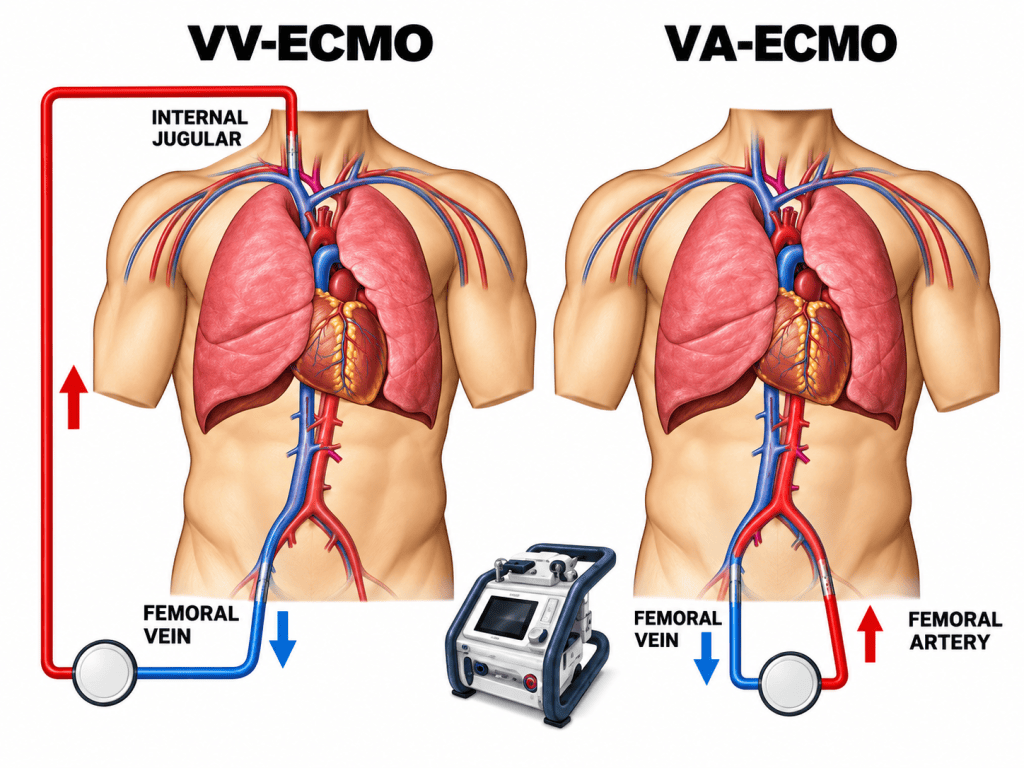
The two main modes of ECMO are veno-venous (VV-ECMO) and veno-arterial ECMO (VA-ECMO).
VV-ECMO
In VV-ECMO, blood is taken from a vein and returned via a vein. It is used predominately for supporting patients with acute respiratory failure.
VA-ECMO
In VA-ECMO, blood is taken from a vein and returned via an artery. It is used to support patients with acute cardiac failure.
Indications and contraindications
VV-ECMO is indicated in patients with acute severe hypoxaemic respiratory failure due to moderate/severe acute respiratory distress syndrome (ARDS) that may be the result of pneumonia or influenza; or secondary to an extrapulmonary insult that leads to lung injury, for example sepsis, severe burns or trauma.
These patients are usually ventilated and are often unable to achieve adequate gas exchange despite increasing concentrations of oxygen and ventilator driving pressures — settings which can lead to further lung injury.
In these patients ECMO can be used as rescue therapy for refractory hypoxaemia, and/or to permit lung-protective ventilation until the underlying lung disease resolves.
At the time of publication, patient selection criteria for VV-ECMO included: age <65, mechanical ventilation <7 days, potentially reversible lung disease, a Murray score >3 (a lung injury score that comprises hypoxaemia severity, ventilator settings and the number of lung quadrants infiltrated), and no limitations on life-sustaining treatment.
In veno-venous ECMO, the patient’s arterial PO₂ (partial pressure of oxygen) is dependent upon ECMO blood flow, oxygenator efficiency, haemoglobin (Hb) concentration, FiO₂ of the gas mixture and contribution of the native lung to gas exchange.
In severe ARDS, the majority of gas exchange occurs within the ECMO circuit itself, with little contribution of the native lung. Veno-venous ECMO does not provide any support for the failing heart as the oxygenated blood is returned to the right heart.
Veno-arterial ECMO is indicated in patients with acute cardiac failure that is potentially reversible. Indications for VA-ECMO include acute myocarditis, cardiogenic shock, poisoning with cardiotoxic drugs (e.g. calcium-channel blockers), massive pulmonary embolism and refractory cardiac arrest.
It is also used for haemodynamic support in patients who fail to wean from cardiopulmonary bypass following cardiac surgery, primary graft failure following a heart transplant or as a bridge to cardiac transplantation in patients with decompensated acute-on-chronic heart failure, or for longer-term support such as a ventricular assist device (VAD).
In VA-ECMO, gas exchange and cardiac output of the failing heart can be augmented. The retrograde arterial blood flow provided by the ECMO circuit will “compete” with the native cardiac function. The final cardiac output will therefore be a function of the VA-ECMO flow and that provided by the patient’s intrinsic cardiac activity.
In the UK, VV-ECMO is commissioned to be provided by five severe acute respiratory failure (SARF) centres across the critical care network, which facilitates equity of access and timely referral. In contrast, VA-ECMO is non-commissioned, and hospitals providing VA-ECMO do so at their own cost, without the financial support of NHS England.
Data from an international registry (Extracorporeal Life Support Organisation) demonstrated survival to discharge or transfer for respiratory ECMO (VV-ECMO) in 59% of cases (9,649 ECMO runs); for cardiac ECMO (VA-ECMO), survival to discharge or transfer was 42% (6,747 ECMO runs).
About the authors
The authors of this article all worked at the Royal Brompton Hospital.
Richard Purchon was a Senior Operating Department Practitioner.
Naoise O’Ciardha and Chris Bishop were both Senior Clinical Perfusion Scientists.
Publication: OTJ, Issue 341, February 2019, p.9.

