A 2019 reconnaissance into the practicality of Via Ferrata for Explorer Scouts in the Bernese Oberland
In August 2019, a reconnaissance expedition to Kandersteg in Switzerland’s Bernese Oberland set out to answer what initially appeared to be a relatively straightforward question:
Could Via Ferrata form part of the activity programme for Explorer Scouts during a future county expedition to Kandersteg International Scout Centre?
This was not simply a climbing holiday. The purpose was to assess Via Ferrata as an organised youth activity: its technical difficulty, exposure, physical demands, equipment requirements, transport, costs and logistics, and ultimately whether suitably experienced Explorer Scouts could undertake it safely and enjoyably.
Four contrasting Klettersteig were examined:
- Mürren–Gimmelwald
- Eiger–Rotstock
- Schwarzhorn
- Kandersteg–Allmenalp
The reconnaissance ultimately produced an unexpected conclusion.
The climbing was achievable. The logistics worked. The equipment requirements were manageable. Appropriately selected Explorer Scouts who were already participating in indoor or outdoor rock climbing appeared more than capable of completing suitable routes.
What ultimately prevented the project from progressing was not the climbing. It was the potential legal responsibility assumed by the adults leading it.
What are Klettersteig and Via Ferrata?
Klettersteig is German, literally meaning a climbing path or climbing route. Via Ferrata is Italian for an iron way.
In practical mountaineering terms, they describe essentially the same activity: a route through steep or exposed mountain terrain equipped with permanent artificial protection and aids such as steel cables, iron rungs, pegs, ladders and, on some routes, suspension bridges and Tyrolean traverses.
Participants normally wear a climbing harness connected to the fixed cable through a purpose-designed energy-absorbing Via Ferrata set incorporating two connectors. At cable anchors, one connector is transferred before the second, maintaining continuous attachment to the protection system.
Klettersteig therefore occupies an interesting territory somewhere between mountain walking, scrambling and rock climbing.
It was precisely this combination that made it attractive as a potential Explorer Scout activity. It offered genuine mountain travel and exposure without requiring every participant to possess the technical independence expected of a traditional rock climber or alpinist.
How difficult is a Klettersteig?
Switzerland predominantly uses the Hüsler Klettersteig scale, which runs from K1 to K6:
K1 — Easy
K2 — Medium
K3 — Fairly difficult
K4 — Difficult
K5 — Very difficult
K6 — Extremely difficult
The Swiss Alpine Club’s grading takes into account far more than the hardest individual climbing move. The nature of the terrain, exposure, length, protection, approach and descent all contribute to understanding the overall undertaking. Modern SAC descriptions can further distinguish mountain experience, strength, endurance and psychological demand.
This exposes an immediate problem when attempting to compare Via Ferrata with conventional climbing grades.
A K4 is not simply the Via Ferrata equivalent of British HVS.
Nor can K2 be translated directly into a particular British scrambling grade.
They measure different things.
Comparing Via Ferrata with British rock climbing
From the perspective of an experienced British climber, the technical climbing encountered during the reconnaissance was generally straightforward.
There were occasional individual moves or short passages which, on a personal assessment, might have appeared on rock around British HVS standard, but these were isolated. The climbing certainly wasn’t sustained at anything resembling that standard.
Most of it was considerably easier.
There is also a fundamental difference between climbing an HVS and climbing a Klettersteig.
On an HVS, the climber reads the rock, identifies holds, solves the sequence of moves, places or clips protection and manages the rope. On a Klettersteig, much of that problem has effectively been engineered out of the route.
Iron rungs provide holds. Ladders overcome vertical sections. Pegs provide footholds. The steel cable provides continuous protection.
Consequently, a passage can be spectacularly exposed without being technically difficult.
For an experienced rock climber this occasionally produced a peculiar frustration. There were straightforward sections where moving naturally over the rock felt as though it would have been considerably simpler than repeatedly transferring two connectors around cable anchors.
There was a temptation to think:
It would be easier just to climb this.
But that misses the point.
The clipping system is fundamental to Via Ferrata.
For a youth activity in particular, remaining correctly attached would have to be regarded as an absolute procedural requirement, irrespective of how easy an individual participant found the climbing.
And that raised another question.
If climbing grade alone didn’t adequately describe the challenge, what did?
Technical Difficulty — Exposure — Exertion
The 2019 reconnaissance notebook used a deliberately simple supplementary assessment:
Technical Difficulty
Exposure
Exertion
Each was recorded as Easy, Moderate or Hard.
This wasn’t intended to replace the recognised Klettersteig grading system. It was designed to answer a different question:
What is actually going to make this route difficult for an Explorer Scout?
A technically strong 16-year-old indoor climber might possess more than enough strength and movement skills to complete the climbing but discover that standing on iron rungs with hundreds of metres of empty space beneath their boots produces an entirely different psychological response.
Another participant might relish the exposure but lack endurance.
Another might possess the fitness, confidence and climbing ability but lack the discipline required to operate the twin-lanyard system correctly at every anchor.
For an organised youth expedition, these distinctions matter considerably more than simply asking whether somebody can “climb K3”.
The four routes provided an excellent opportunity to test the idea.
Mürren–Gimmelwald — K3
The Mürren–Gimmelwald Klettersteig is unusual because much of the route effectively travels downwards, traversing the enormous cliffs above the Lauterbrunnen Valley towards Gimmelwald.
The technical climbing isn’t particularly severe.
The exposure is another matter.
The route progressively commits the climber to the cliff, incorporating ironwork, ladders and cable bridges before eventually reaching the spectacular suspension bridge near Gimmelwald.
The 2019 assessment was:
Technical Difficulty: Moderate
Exposure: Moderate
Exertion: Easy
It demonstrated particularly well why conventional climbing ability and Klettersteig competence aren’t necessarily the same thing.
An Explorer accustomed to an indoor climbing wall might find the physical moves straightforward while simultaneously experiencing an enormous psychological transition.
The holds are still there.
The harness is still there.
The connectors are still there.
What has changed is the environment.
There is now an Alpine valley beneath your feet.
For the proposed Explorer programme, Mürren demonstrated that exposure needed to be assessed independently of technical climbing difficulty.
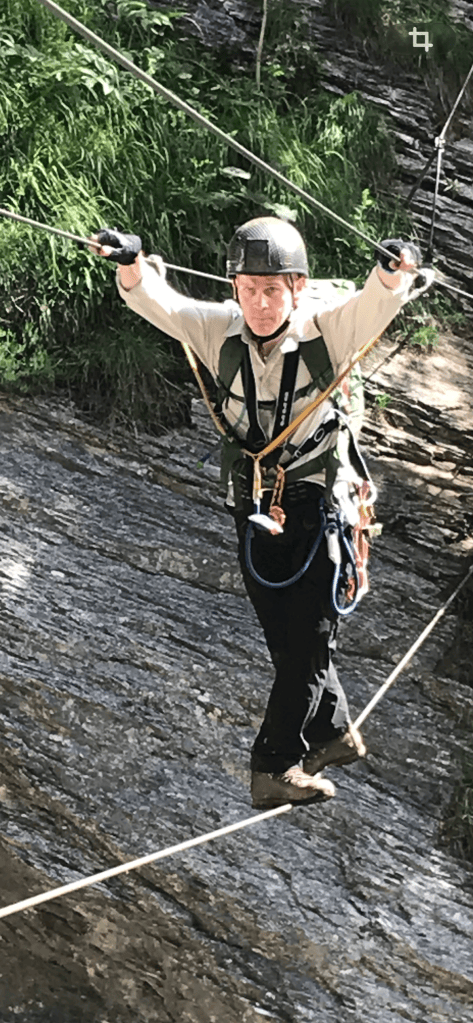
Barry White on the Mürren–Gimmelwald Klettersteig during the 2019 reconnaissance. The photograph illustrates the combination of relatively straightforward protected climbing with the considerable exposure above the Lauterbrunnen Valley that made Mürren such a useful route for assessing the psychological demands of Via Ferrata for Explorer Scouts.
Eiger–Rotstock — K2
The Eiger–Rotstock provided a completely different experience.
The Rotstock rises to 2,662 metres, tucked against the huge architecture of the Eiger. The SAC currently grades its protected route K2, involving around 260 metres of ascent and approximately 1 hour 15 minutes on the Via Ferrata.
The route also possesses a fascinating history.
A protected path existed here between 1899 and 1903 in association with the former Rotstock station during construction of the Jungfrau Railway. The forgotten route was rediscovered in 1997 and subsequently equipped with modern ladders and cables by Grindelwald mountain guides before reopening in 2000.
Our 2019 timings were remarkably close to the modern SAC guide time:
Start: 13:15
Finish: 14:40
Time: 1 hour 25 minutes
The first third involved fixed ladders. The middle section increasingly involved cable-protected movement, while the upper part became more reminiscent of an Alpine scramble.
The contemporary assessment was:
Technical Difficulty: Easy
Exposure: Easy
Exertion: Moderate
Yet Rotstock demonstrated something particularly important for the feasibility study.
The Klettersteig might be K2. The mountain isn’t necessarily K2.
The SAC currently grades the approach T3 and the normal descent T4+, the latter descending around 350 metres over slabs and scree, with fixed ropes in places.
Someone reading only “K2” could therefore substantially misunderstand the complete undertaking.
The K grade describes the protected climbing.
It doesn’t necessarily describe what is required to reach it—or to get safely back down.
Eiger–Rotstock, 2,662 m
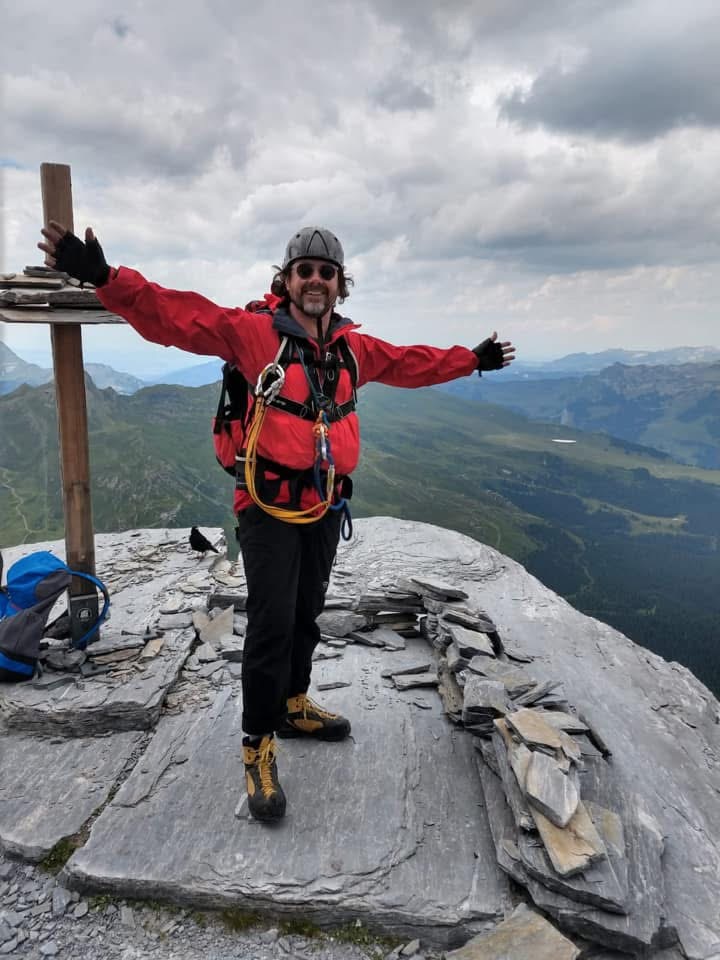
Richard Purchon at the summit cross following completion of the Eiger–Rotstock Klettersteig, August 2019.
The photograph captures another important aspect of the reconnaissance. These weren’t artificial climbing courses detached from the mountain environment. The Klettersteig was a means of reaching a genuine Alpine summit, with all the approach, descent, weather and mountain judgement that implies.
Schwarzhorn — K2–3
The 2,928-metre Schwarzhorn provided another variation.
Here, the Klettersteig was only one component of a substantially longer mountain day.
The reconnaissance involved travelling from Kandersteg to Grindelwald, ascending to Schreckfeld and undertaking a lengthy approach before even reaching the protected climbing.
The notebook records:
Schreckfeld to the metalwork: 2 hours 10 minutes
Klettersteig start: 12:30
Summit: 14:00
Klettersteig: approximately 1 hour 30 minutes
The modern SAC grade is K2–3. The route follows the southwest ridge to an almost vertical tower where around 40 rungs provide passage. Cables then lead towards a second steep section followed by three almost vertical, staggered ladders before easier ground leads towards the summit.
The SAC describes it as a moderately difficult Via Ferrata with a fairly long approach and particularly airy ladders. The complete journey from First is estimated at around five hours. The approach itself is graded T4+, involving approximately two hours and 560 metres of ascent.
Our 2019 assessment was:
Technical Difficulty: Easy
Exposure: Easy
Exertion: Moderate — principally because of the approach and overall mountain day.
Again, the lesson was clear.
A participant could easily possess the climbing ability necessary for a K2–3 Via Ferrata while lacking the mountain fitness or experience required for the complete objective.
Schwarzhorn, 4 August 2019
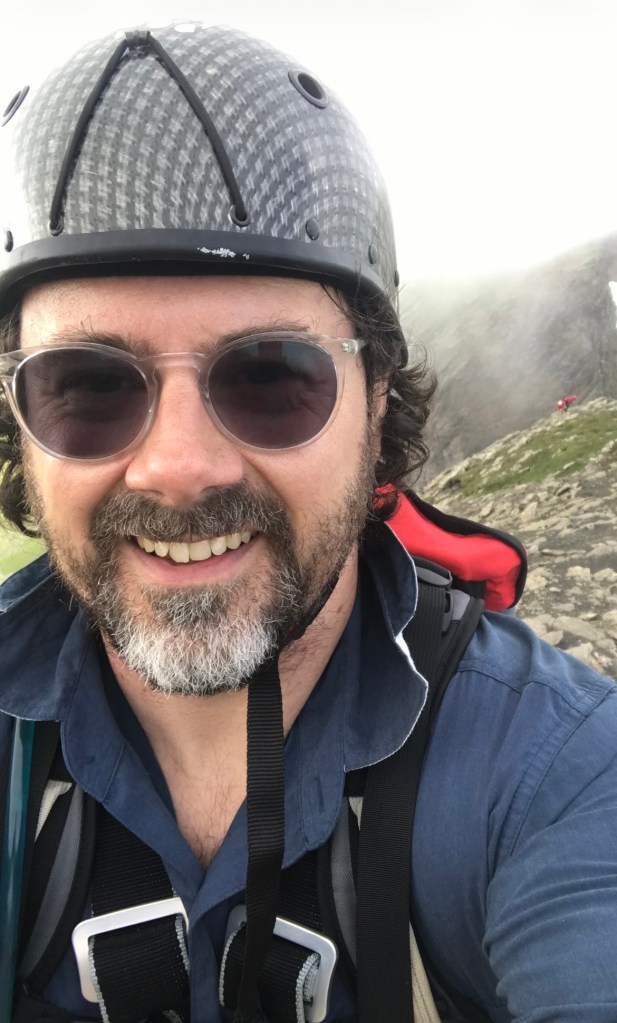
Richard Purchon during the ascent of the 2,928 m Schwarzhorn above Grindelwald.
Reduced visibility in the photograph gives some indication of the high-mountain character of the day. The Schwarzhorn demonstrated particularly well that the protected climbing section cannot sensibly be assessed in isolation from the journey required to reach and leave it.
Kandersteg–Allmenalp — K4
If Rotstock and Schwarzhorn established the easier end of the spectrum, Allmenalp was the real test.
The original information board photographed during the 2019 reconnaissance graded the route K4, giving a normal journey time of three to three-and-a-half hours, 550 metres of total ascent and approximately 350 metres of Klettersteig.
The SAC continues to grade Allmenalp K4. Its modern assessment gives strength 3/4 and psychological demand 3/4 and describes an exposed route directly through a 350-metre wall of pillars and gullies.
Our notebook recorded:
Start: 08:30
Finish: 10:35
Time: 2 hours 5 minutes
The route incorporated fixed ladders, iron pegs, bridges, exposed traverses and Tyrolean features.
The contemporary assessment was unequivocal:
Technical Difficulty: Hard
Exposure: Hard
Exertion: Hard
Kandersteg–Allmenalp, August 2019
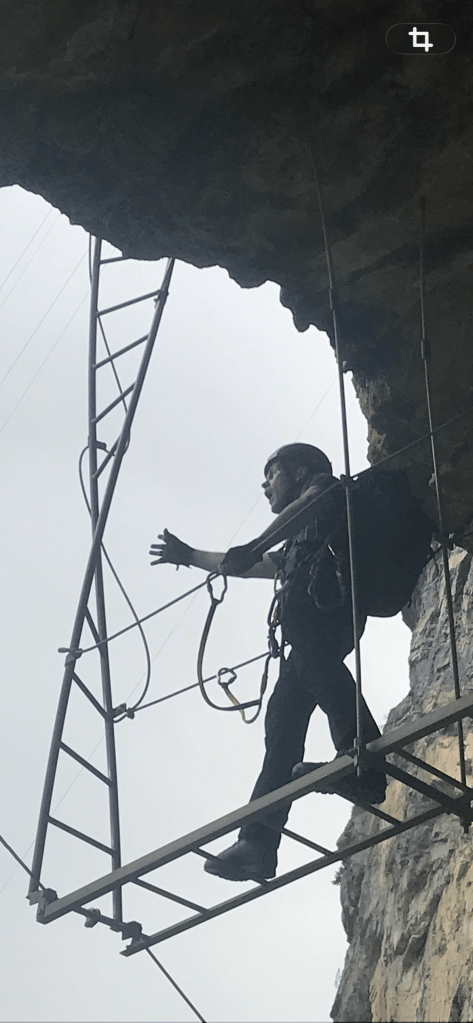
Barry White on the Allmenalp Klettersteig during the 2019 reconnaissance. The route provided the most technically and psychologically demanding test of the four Klettersteig examined, combining steep protected climbing, ladders, ironwork and substantial exposure on the wall above Kandersteg.
But Allmenalp had another lesson waiting for us.
When the weather changed
By the time we were properly committed to the route, the weather deteriorated.
Heavy rain arrived.
Then came thunder.
Then lightning.
What had started as a challenging but manageable K4 suddenly became something considerably more serious than the grade printed on the information board.
Straightforward retreat was no longer a practical option. We were committed to the protected line, and the realistic course was to continue upwards and get off the route.
There was also an uncomfortable irony to our predicament.
The safety system upon which Via Ferrata depends involves clipping yourself continuously to a steel cable running across an exposed mountain face.
During an electrical storm, that suddenly feels considerably less reassuring.
The rain transformed the climbing as well. Rock became wet. Footing became less secure. Metal rungs and ladders became slippery.
Then the lightning began striking nearby.
Each close strike produced essentially the same reaction.
We stopped.
Looked at one another.
There was no need for much conversation.
The expression effectively asked:
“Still alive?”
Then we carried on.
It was frightening and exhilarating at the same time—that peculiar combination of concentration, apprehension and adrenaline produced when a mountain suddenly becomes substantially more serious than the route description suggested.
The recorded 2 hour 5 minute completion time therefore deserves some context.
There was considerable incentive to keep moving.
The objective had ceased simply to be completing Allmenalp efficiently.
It had become:
Get off an exposed Klettersteig during an electrical storm.
And Allmenalp provided perhaps the clearest lesson of the entire reconnaissance:
A K4 grade describes the Klettersteig. It cannot describe what the mountain may add to it.
The same K4 on dry rock beneath a blue Alpine sky and in torrential rain with lightning striking nearby occupies exactly the same line on the mountain.
But it is emphatically not the same undertaking.
For an Explorer Scout programme, that mattered enormously.
It wasn’t sufficient to ask whether an Explorer possessed the technical ability to climb Allmenalp.
The leader also had to ask:
What happens if the weather changes after a group of young people has passed the point where straightforward retreat remains possible?
That was a very different question.
Equipment: what we actually used
Equipment formed another important part of the reconnaissance.
A contemporary photograph shows climbing partner Barry White equipped for the Klettersteig with:
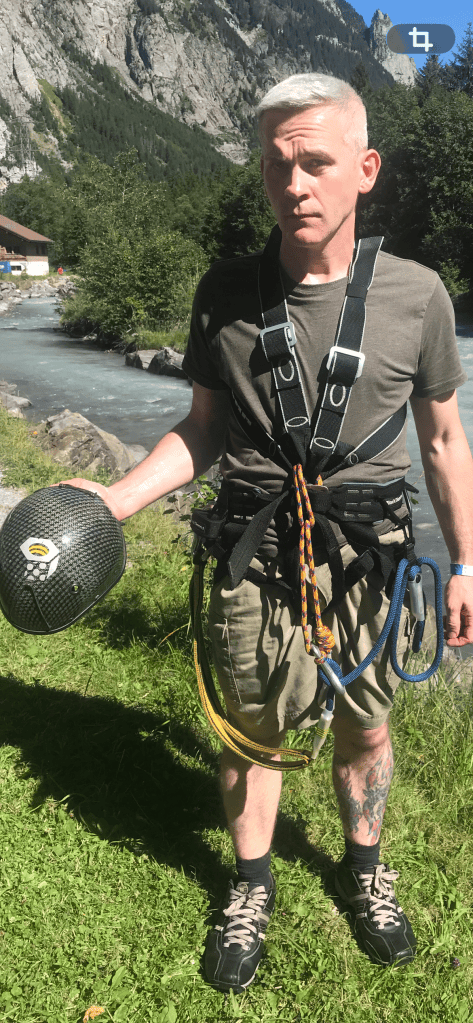
Black Diamond mountaineering sit harness
DMM chest harness
Petzl Zyper Via Ferrata energy-absorbing lanyards
Black Diamond carbon/Dyneema climbing helmet
British Army-issue mountain boots
The photograph is useful as a historical record of the equipment actually being used during the reconnaissance rather than as a prescription for what someone should purchase today.
The original notebook also contains a hand-drawn lanyard arrangement.
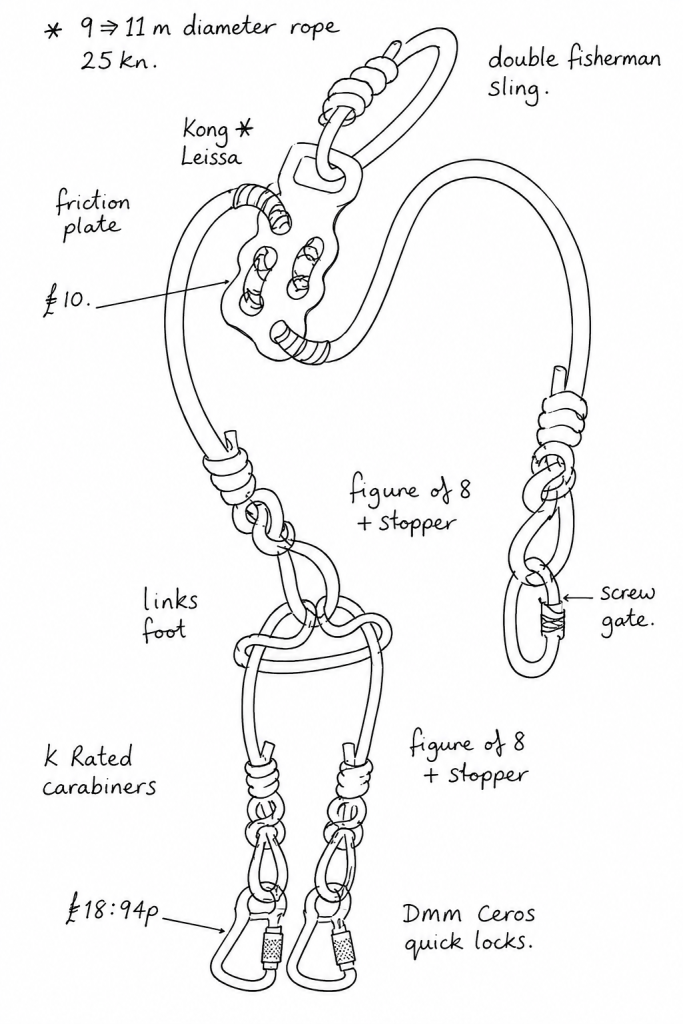
This was not the system used on the routes.
It was an equipment and cost investigation exploring whether lanyards could economically be constructed from recognised climbing components and conventional climbing knots, including rated connectors, climbing rope and an energy-absorbing friction device.
The exercise raised an interesting equipment question, but the drawing should be understood in its historical context rather than interpreted as instructions for constructing a modern safety-critical Via Ferrata system.
Could Explorer Scouts actually do it?
After completing the four routes, the answer was broadly:
Yes.
For appropriately selected UK Explorer Scouts already regularly participating in indoor or outdoor rock climbing, the fundamental climbing ability required for suitable Klettersteig didn’t appear to present an unreasonable obstacle.
Indeed, technical climbing ability was probably not the principal limiting factor.
More important were exposure, fitness, endurance, mountain awareness, confidence and the discipline necessary to operate the protection system correctly throughout the route.
From an activity perspective, the concept looked extremely promising.
Via Ferrata offered something an indoor climbing wall simply couldn’t reproduce.
It placed climbing skills into a genuine mountain environment.
It introduced exposure.
It demanded endurance.
It required personal discipline.
It allowed progression from relatively straightforward protected routes to substantial mountain objectives.
And Kandersteg provided access to all of this within a remarkably compact area.
From a technical and logistical perspective, the reconnaissance suggested that the programme could work.
But that wasn’t the end of the assessment.
The problem wasn’t the climbing
The issue that ultimately changed the recommendation was legal responsibility.
An important case had been discussed by the Swiss Alpine Club in 2018, the year before our reconnaissance.
Following an avalanche accident, the Higher Regional Court in Linz, Austria, convicted a then 65-year-old ski tourer of negligent homicide. His 59-year-old wife and long-standing mountain partner had been killed.
The accident and prosecution occurred in Austria, not Switzerland.
But the significance for our purposes was the subsequent discussion by the Swiss Alpine Club, because the SAC used the case to examine the concept of the faktischer Führer — the “de facto leader” — and its relevance in Switzerland.
That changed the equation.
The de facto leader
The principle described by the SAC is remarkably relevant to an organised youth expedition.
Where a group consists of people with comparable mountain experience and decisions are genuinely made collectively, normally nobody is regarded as the faktischer Führer.
The situation can be different where one person possesses substantially greater mountain experience than the others and those less-experienced participants rely upon that person’s judgement and instructions.
That individual may effectively acquire the role of de facto leader even though nobody formally appointed them as such.
The SAC’s article explains that the decisive issue is not simply age or title but the practical relationship between the participants. It quotes Valais prosecutor Fabienne Jelk explaining that once somebody effectively assumes leadership, the planning and precautions expected can include detailed route planning, checking hazard information, controlling equipment, making assessments in the terrain and giving clear instructions.
It is important not to overstate what this means.
Swiss law does not make the most experienced mountaineer automatically criminally responsible whenever an accident occurs.
Nor does the occurrence of a fatality automatically establish negligence.
The circumstances matter, as does whether an applicable duty of care was actually breached.
But for the proposed Explorer Scout programme, the implications were impossible to ignore.
From climbing partner to Scout leader
Consider two similarly experienced adult climbers.
They select their route together.
They assess the weather together.
They decide collectively whether to continue.
Neither is particularly dependent upon the other’s judgement.
Now consider an organised party of Explorer Scouts undertaking a Klettersteig.
Who selected the route?
Who decided that the weather was acceptable?
Who determined whether the participants possessed sufficient experience?
Who established the equipment requirements?
Who checked that equipment?
Who taught participants how to use the Via Ferrata system?
Who decided whether the party should continue or retreat?
The adult leaders.
It would be difficult to characterise such a group as a collection of equally experienced mountaineers independently making their own decisions.
The leadership relationship would be inherent.
And there was an uncomfortable paradox within this.
The experience that made an adult suitable to lead the activity could simultaneously help establish that less-experienced participants were relying upon that person’s judgement.
The SAC’s explanation of faktische Führerschaft was therefore directly relevant.
If the legal system could examine whether one experienced adult had effectively assumed responsibility within a private climbing or ski-mountaineering partnership, the potential duty of care within an organised group of minors under adult leadership was difficult to dismiss.
Insurance couldn’t remove the problem
This wasn’t simply a matter of arranging adequate insurance.
Insurance can address defined rescue expenses, medical costs or civil liabilities according to the policy concerned.
It cannot remove potential criminal responsibility for an individual’s own conduct.
Again, this doesn’t mean that an adult leader would automatically be prosecuted or convicted simply because an accident occurred.
The concern was that following a catastrophic accident, the leader’s decisions and fulfilment of their duty of care could become matters for legal examination.
For professional mountain guides, legal responsibility is an accepted component of a professional role.
For volunteers contemplating taking young people onto exposed Alpine routes, it produced a rather different risk-benefit calculation.
And our experience on Allmenalp suddenly made the issue much less theoretical.
We had entered the route intending to climb a K4.
Later, we found ourselves committed to an exposed wall in heavy rain and an electrical storm.
As two experienced adult climbers, we were responsible for ourselves and could react accordingly.
Now substitute an organised group of Explorer Scouts.
Who made the decision to start?
Who checked the forecast?
Who decided that continuing was safer than retreating?
Who was responsible for the least experienced member of the group?
Those questions could be answered quite differently after an accident than they might be over breakfast before leaving Kandersteg.
The unexpected conclusion
The 2019 reconnaissance therefore reached an unusual conclusion:
The Klettersteig passed the test. The proposed Explorer Scout programme did not.
The four routes demonstrated that Via Ferrata could provide an exceptional programme of progressive mountain activities.
The equipment was manageable.
The transport and logistics were workable.
The technical climbing was within the capabilities of appropriately selected Explorer Scouts.
But the reconnaissance also demonstrated that technical difficulty alone is a poor measure of the seriousness of a Klettersteig.
Mürren demonstrated the psychological significance of exposure.
Eiger–Rotstock showed how an apparently modest K2 protected route could sit within a mountain journey involving a significantly more serious descent.
Schwarzhorn demonstrated how a K2–3 Via Ferrata could form only a comparatively short section of a much longer and more physically demanding mountain day.
Allmenalp demonstrated what happens when an already serious K4 is transformed by deteriorating weather after commitment to the route. Its official K4 grade remains entirely appropriate, but no static grade can communicate the effect of rain and an electrical storm on an exposed metal-protected cliff.
The notebook’s deliberately simple assessment of:
Technical Difficulty / Exposure / Exertion
therefore proved remarkably useful.
It didn’t compete with the official grading system.
It answered a different question.
Why might this particular route become difficult for this particular participant?
But ultimately none of those physical factors killed the project.
Responsibility did.
The purpose of reconnaissance
There is perhaps a broader lesson here about expedition planning.
Reconnaissance should never simply be an exercise designed to confirm a decision already made.
Its purpose is to discover what you don’t know.
In August 2019 we went to the Bernese Oberland principally to determine whether Explorer Scouts could realistically undertake Via Ferrata during a future county expedition to Kandersteg International Scout Centre.
Four very different routes provided the answer.
Yes. Appropriately experienced Explorers probably could.
The technical standard wasn’t the obstacle.
The equipment wasn’t the obstacle.
The transport wasn’t the obstacle.
The logistics weren’t the obstacle.
Even the extraordinary exposure wasn’t necessarily the obstacle, provided participants were appropriately selected, trained and progressively introduced to it.
But the reconnaissance uncovered another question:
Should volunteer adult leaders accept the potential legal responsibility associated with taking young people into that environment?
For the proposed programme, the conclusion was no.
Not because the Explorers lacked the ability.
Not because Via Ferrata was inherently too dangerous.
Not because Kandersteg was unsuitable.
And not because the programme couldn’t be made to work.
The deciding factor was that the potential personal legal exposure of the adults responsible for the young people was considered disproportionate to the benefit of adding Via Ferrata to the expedition programme.
That meant abandoning an activity which, from a purely mountaineering perspective, had passed virtually every test we had set for it.
Perhaps that was the most important result of the entire expedition.
Sometimes the mark of a successful reconnaissance isn’t returning home knowing how to proceed.
It is returning home with enough information to know when not to.
Sources and Further Reading
Swiss Alpine Club — Eiger–Rotstock Via Ferrata — official route description, grading, history and timings.
Swiss Alpine Club — Schwarzhorn Via Ferrata — official K2–3 route description, approach and overall character.
Swiss Alpine Club — Kandersteg–Allmenalp Via Ferrata — official K4 grading and route description.
Swiss Alpine Club — “Die unsichtbare Last der Routiniers” — the SAC’s 2018 examination of the faktischer Führer, or de facto leader, and the potential responsibilities assumed by the more experienced member of a mountain party.
Historical timings, personal difficulty assessments, equipment descriptions and the account of the 2019 weather conditions are taken from the original August 2019 reconnaissance notes and photographs. Current SAC grades and route descriptions are included for comparison and should not be interpreted as an assessment of present-day route or weather conditions.
 purchonrichard-yobgv