An ascent of Africa’s highest mountain — told through the first-hand experience of SAS veterans
At 5,895 metres, Kilimanjaro is routinely described as a trekking peak. Technically, that is correct. The normal routes require no sustained rock climbing or complex alpine techniques.
But non-technical should never be confused with easy.
In 2025, a group of SAS veterans set out to climb Africa’s highest mountain. Some had not seen one another for more than twenty years. All had, in a previous life, experienced arduous military selection and understood discomfort, exhaustion and the value of simply continuing to put one foot in front of another.
The problem was that much of that had happened, as their expedition account rather painfully observes, “in the last century.”
They were older. There were decades of accumulated injuries. Recovery was rather slower. Getting out of a tent had become considerably more challenging than anyone remembered.
What followed was an eight-day expedition involving altitude, cold, dust, coughing, stomach problems, extraordinary Tanzanian support, relentless abuse between old friends and a remarkable demonstration of determination.
Fifteen veterans started. Twelve reached the summit.
This is their story.
The Long Road Up
Kilimanjaro does not necessarily reveal its difficulty at the beginning.
It accumulates it.
Day follows day. Distance accumulates. The altitude increases. Sleep becomes less restorative and the body gradually begins to notice that the atmosphere is providing rather less oxygen than it would prefer.
By the end of the expedition, the team had covered approximately 145 kilometres and gained more than 3,350 metres of elevation.
Then there was the dust.
It got into clothing, equipment and tents. As the expedition climbed higher, coughing became an increasingly prominent feature of camp life.
Yet a routine quickly developed.
Wake-up was normally between 06:00 and 06:30, often accompanied by the unexpected luxury of a porter appearing with a brew.
There were occasional disagreements over exactly what 06:00 wake-up meant.
As the veterans’ account records:
“Obviously for some a 0600 wake up time meant waking up and having the loudest conversation possible in the whole of East Africa, at 0415, describing in detail how bright their head torches were.”
The proposed military solution to this behaviour was considerably less diplomatic.
“We all know these types, and yes, they should be taken outside and stoned.”
Some aspects of military humour apparently survive retirement remarkably well.
Breakfast — Assuming You Could Get Out of the Tent
Breakfast was normally at 07:00.
But first came the day’s opening physical challenge.
Getting out of the tent.
The veterans describe themselves as:
“A bunch of rather damaged 60-year-olds”
attempting to extract themselves from tents apparently possessing approximately eight and a half inches of headroom.
For some, this achievement alone apparently necessitated a short rest.
Breakfast increasingly took place amid coughing.
Water bottles were filled, equipment gathered and the guides would gently — but firmly — point everybody in the correct direction.
Then they started walking.
Again.
After another day of walking, coughing, confusion and dust, they would eventually arrive at the next camp.
Except the camp was already there.
The People Who Made the Expedition Possible
One of the most striking aspects of the veterans’ account is not what they say about themselves.
It is what they say about their Tanzanian guides and porters.
Their assessment of the support was unequivocal:
“Unbelievable.”
The expedition was supported by nine guides and a substantial team of porters.
Each morning the veterans would leave camp and begin climbing.
Behind them, the porters dismantled the entire camp, packed the equipment and loaded everything required to keep the expedition moving.
They then set off.
And overtook them.
For a collection of men with certain previous experience of physical endurance, being repeatedly overtaken by porters carrying enormous loads apparently generated a healthy sense of inadequacy.
The veterans recalled:
“What the Porters achieved whilst wearing a 1996 Arsenal T shirt, Woolworth tracksuit bottoms and Dunlop plimsolls, was astounding.”
Some carried loads on their heads.
One was observed carrying a portable toilet in precisely this fashion.
By the time the veterans finally reached the next camp, the porters had already arrived and rebuilt it.
And there was a hot brew waiting.
The account’s judgement could hardly be clearer:
“I just cannot give these guys and girls enough credit.”
Nor should we.
The familiar photograph of a successful Kilimanjaro expedition shows trekkers standing beside the summit sign.
It rarely shows the extraordinary logistical operation supporting them.
The guides manage the pace and mountain.
The cooks somehow produce meals in increasingly inhospitable surroundings.
The porters repeatedly move the infrastructure of an expedition uphill.
Kilimanjaro may be climbed by the people whose photographs appear on the summit.
But their success is made possible by a much larger team.
Nights on the Mountain
Evenings developed their own rhythm.
Food.
Conversation.
Coughing.
Then bed.
As befitted their generation, the veterans were generally inside their sleeping bags by about 21:00.
Initially they were lulled to sleep by gentle snoring.
Then they climbed higher.
As altitude and dust increased, snoring was progressively replaced by coughing and wheezing.
Finally came the night before the summit attempt.
The account records:
“There was a definite faint sound of sobbing around the camp.”
Nobody appears to have investigated further.
Probably wisely.
Day Seven: Summit Day
At 23:15, boots started going on.
The group was due to begin its summit attempt at 23:30.
There was something strangely familiar about the situation.
Several veterans couldn’t help noticing similarities with Test Week:
“Five days walking, followed by a silly early start on the penultimate day.”
Some memories apparently never disappear.
The first six hours were remarkably quiet.
There was little conversation.
In darkness, the mountain contracted to the small pool of light produced by a headtorch and the boots of the person immediately ahead.
And still there was dust.
At this altitude, speed becomes increasingly irrelevant.
The objective is simply movement.
One foot.
Then the other.
Repeat.
For hours.
Dawn
Eventually the darkness began to lift.
Dawn appeared over East Africa and morale improved with it.
But the altitude was beginning to exert an increasingly powerful influence over the expedition.
The group started to separate.
This is one of the realities of high altitude: people respond differently.
Fitness helps.
Experience helps.
Determination certainly helps.
But none of them provides immunity from hypoxia.
As the team climbed beyond 5,000 metres, individual differences became increasingly apparent.
Some continued relatively strongly.
Others slowed.
Some were struggling significantly.
After approximately seven hours, the leading group finally reached the crater rim at Stella Point — 5,756 metres.
It was a huge psychological milestone.
But Stella Point isn’t the summit.
There was still another journey to make.
Through the Summit Ice
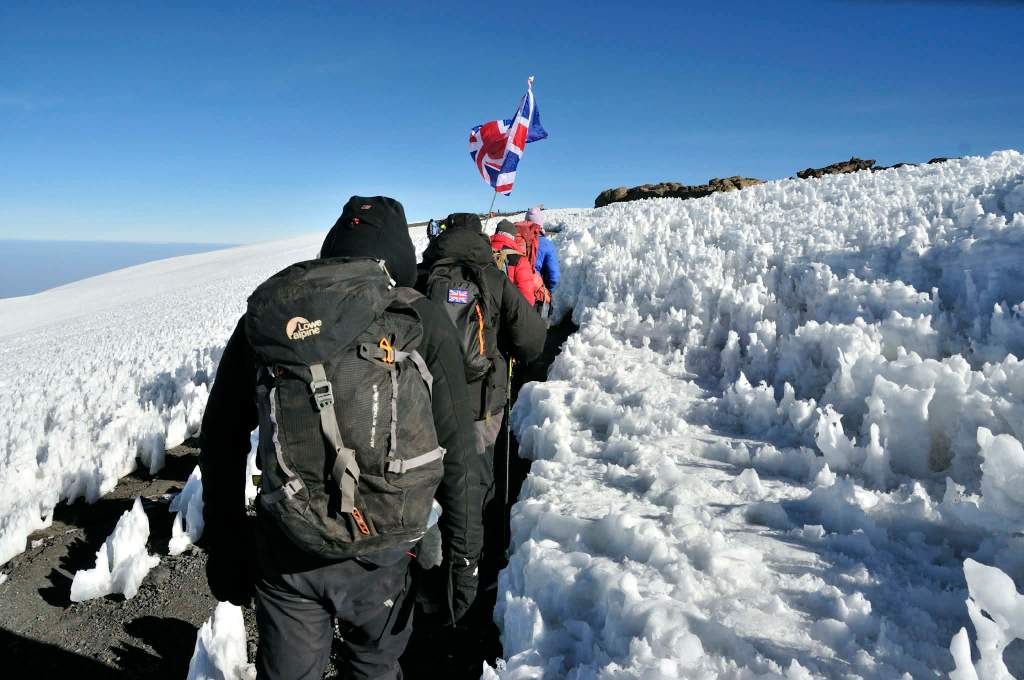
The final approach towards Uhuru Peak, Kilimanjaro, 2025. SAS veterans moving through the remnants of Kilimanjaro’s summit ice at almost 6,000 metres following the overnight ascent. Photograph courtesy of the 2025 SAS Veterans Kilimanjaro Expedition.
The photograph captures something that the description trekking peak can sometimes fail to convey.
This is still a high mountain.
Beyond Stella Point, the veterans continued towards Uhuru through the extraordinary ice formations of Kilimanjaro’s summit environment.
They described it as:
“A short, and breathless, traverse through the glacier field.”
Short is a relative concept at nearly 6,000 metres.
Every movement requires considerably more effort.
Eventually, at approximately 08:00, members of the team reached:
UHURU PEAK — 5,895 METRES
The roof of Africa.
“Biden”
Within the expedition was its oldest participant.
Inevitably, his friends had provided him with a nickname.
“Biden.”
His supposed status as the expedition’s resident geriatric became a reliable source of entertainment.
He was, according to the traditions of such friendships, comprehensively ripped for being old.
But behind the jokes was something rather more impressive.
He kept going.
Another veteran was climbing despite the legacy of particularly significant previous injuries.
Others encountered substantial difficulties as altitude and exhaustion took their toll.
Yet several demonstrated extraordinary determination simply to continue.
Failure was not going to be accepted casually.
By the conclusion of the summit attempt:
12 OF 15 HAD SUMMITTED.
The veterans’ account describes the sheer resolve demonstrated by some members as:
“Truly inspirational.”
It is difficult to disagree.
Getting Up Is Optional. Getting Down Isn’t.
Reaching the summit produces an enormous psychological release.
Unfortunately, the mountain hasn’t finished with you.
The descent caught several of the veterans out.
They had already been moving for hours. Energy reserves were depleted. Legs were tired and concentration was beginning to suffer.
Eventually everybody made it back to Barafu Camp.
But summit day still wasn’t over.
They then had to descend another several hundred metres to Mweka Camp.
For many of the group, the day ultimately involved more than sixteen hours on their feet.
That statistic alone deserves consideration whenever Kilimanjaro is casually dismissed as just a trek.
Its technical demands may be relatively modest.
Its physiological and physical demands are not.
Bloody-Mindedness
One of the veterans’ principal Lessons Identified was bloody-mindedness.
All had previously completed some form of arduous military selection.
They understood suffering and sore feet.
They understood that sometimes the solution to being tired was simply to continue.
But there was an important difference.
Most of those experiences had happened decades earlier.
Bodies age.
Old injuries return to collect their debts.
The oldest member of the expedition had already provided plenty of material for jokes.
Another member was attempting the mountain carrying the consequences of significant previous injuries.
Others developed problems during the ascent.
Yet they continued where it remained safe to do so.
This matters.
Summit success should never take priority over safety at altitude. Turning around when circumstances demand it is sound mountain judgement, not failure.
But equally, there are moments when the difference between stopping and continuing is simply the willingness to endure discomfort.
Several members of this expedition demonstrated that quality in abundance.
Age had changed their bodies.
It had apparently done rather less to their determination.
Camaraderie
Perhaps the most important lesson had nothing to do with altitude.
Some members of the expedition had not seen one another for more than twenty years.
Yet the intervening decades disappeared remarkably quickly.
The veterans’ account summarises the reunion beautifully:
“Don’t you still owe me a fiver?”
Shared adversity creates unusual relationships.
People move away.
Careers change.
Families grow.
Twenty years disappear.
Then put the same people together with a difficult objective, inadequate oxygen and enough opportunities to take the piss out of one another and the old relationships rapidly reappear.
Kilimanjaro was becoming about considerably more than reaching a summit.
Humour: Essential Expedition Equipment
People developed stomach problems.
People fell over.
People coughed.
People struggled to escape tents.
People became exhausted.
Naturally, their companions found much of this extremely funny.
But there is something more significant behind the humour.
Humour is an effective response to adversity.
It reduces tension.
It protects morale.
It transforms today’s misery into tomorrow’s story.
Within groups that have experienced hardship together, taking the piss can also represent a peculiar form of affection that outsiders may find difficult to understand.
Kilimanjaro provided plenty of material.
The veterans made full use of it.
Command and Control
Some expedition reports require detailed analysis of leadership and command structure.
This one did not.
The entire assessment was:
“Biffo tried.”
There seems little point expanding upon such a comprehensive review.
A Few Statistics
Everyone likes statistics.
Distance covered: approximately 145 km
Elevation gain: more than 3,350 m
Summit altitude: 5,895 m
Summit conditions: approximately –20°C
Atmospheric oxygen availability: roughly half that experienced at sea level
Expedition members: 15
Successful summits: 12
Summit day: more than 16 hours on foot for some members
And perhaps most importantly:
Number of members who asked if there was anywhere to go for a walk after the Day Three march: 1.
There is always one.
Day Eight: Where’s My Carer?
After summit day there remained one final objective.
Get off the mountain.
Another seven hours of descending took the team through the rainforest towards Mweka Park Gate.
Vegetation returned.
The air became thicker.
Eventually they were reunited with the brown dust.
Eight days.
Approximately 145 kilometres.
5,895 metres.
Twelve summits.
Job done.
The final assessment was perhaps inevitable:
“Where’s my carer? I want to go home now.”
Conclusion: The Ethos Remains
The popular image of Kilimanjaro is a photograph beside the famous Uhuru Peak sign.
Smiling faces.
Raised arms.
A flag.
Perhaps thirty seconds representing an eight-day expedition.
What that photograph doesn’t show is arguably more important.
It doesn’t show the dust.
It doesn’t show the coughing.
It doesn’t show the sleepless nights or stomach problems.
It doesn’t show people struggling quietly with altitude.
It doesn’t show the 23:30 departure or the sixteen-hour summit day.
It doesn’t show decades-old injuries suddenly making their presence known at 5,000 metres.
And it rarely shows the Tanzanian guides, cooks and porters working relentlessly behind the scenes to make the expedition possible.
The 2025 SAS Veterans Kilimanjaro Expedition tells a different story.
These were no longer the young men who had once undergone arduous military selection.
Decades had passed.
Bodies had accumulated damage.
Some had not seen each other for more than twenty years.
Yet put them together again in an environment involving discomfort, uncertainty, physical adversity and a sufficiently unreasonable objective, and something familiar emerged.
Camaraderie.
Humour.
Bloody-mindedness.
Esprit de corps.
And the determination to keep moving when continuing became uncomfortable.
The veterans concluded that the physical, mental and emotional challenge of Kilimanjaro demonstrated that the Ethos still ran deeply through them.
Perhaps that is the most important point.
Kilimanjaro did not recreate those qualities.
The mountain merely provided somewhere high enough, cold enough and difficult enough to demonstrate that they had never disappeared.
Twelve reached the roof of Africa.
But the expedition demonstrated something that cannot be measured in metres.
More than twenty years after some had last stood alongside one another, the bonds formed through shared service remained.
The Ethos remains.
Source & Acknowledgement
This article has been produced from a first-hand account supplied by SAS veterans who participated in the 2025 Kilimanjaro expedition. Their observations, statistics, humour and reflections form the primary source for this account.
For reasons of personal and operational security, individual participants are not identified by their real names, former squadron affiliations or other unnecessarily identifying details. Nicknames contained within the original account have been retained where appropriate.
Full credit for the original account rests collectively with the SAS veterans who undertook the Kilimanjaro expedition, with acknowledgement to the SAS Association for its support.
Particular recognition must also be given to the Tanzanian guides, porters, cooks and support staff whose professionalism, strength and extraordinary logistical contribution made the expedition possible.
Source: First-hand participant account — SAS Veterans, Kilimanjaro Expedition, 2025.

