Thank You for Your Service — Now Get Back to Work
Richard Purchon FRGS AC RODP
There is a phrase Americans use which makes many British people slightly uncomfortable:
“Thank you for your service.”
We tend to find it rather theatrical.
Perhaps that says more about us than it does about them.
Whatever criticisms can legitimately be made of the United States’ treatment of its veterans, there remains a strong cultural understanding that serving your country means something. Military service carries an identity long after the uniform has been taken off.
Britain is rather more complicated.
We commemorate service extremely well.
We have Remembrance Sunday.
We have Cenotaphs.
We have military medals.
We wear poppies.
Politicians stand solemnly while wreaths are laid.
But recognising service ceremonially and accepting an obligation towards the person who served are not necessarily the same thing.
And increasingly I wonder whether Britain has forgotten the difference.
When the Veteran Needs His Country
A good friend of mine served in the Parachute Regiment and subsequently the SAS.
Through circumstances that were no fault of his own, he eventually found himself homeless.
So he did what somebody in that position is supposed to do. He approached his local authority for help.
His recollection of the response has remained with me ever since:
“You’re not an immigrant, disabled, or a single parent. You’re not entitled to housing.”
That is his recollection of what a council employee told him. I am not suggesting that those words constitute British housing law.
In fact, current English housing guidance formally provides particular protection for veterans. Local authorities must give additional preference to certain former members of the Armed Forces who already fall within housing-need categories and have urgent housing needs. Veterans are also exempt from some local-connection restrictions. (GOV.UK)
But there is an extraordinary qualification.
Government guidance itself states:
Being a veteran does not guarantee that you will be given social housing. (GOV.UK)
That is the distinction that matters.
There is a separate system of asylum support under which a destitute person seeking asylum may be provided somewhere to live and financial subsistence while their claim is considered. That is not the same thing as being allocated a council house, and the two systems should not be confused. Accommodation for asylum seekers is generally provided on a no-choice basis. (GOV.UK)
Nor does any of this mean that somebody fleeing persecution should simply be abandoned.
That is not my argument.
My question is much simpler.
How can service to your country fail, in itself, to guarantee that the country you served will not leave you homeless?
From the pavement, distinctions between different government departments, statutory schemes and housing classifications probably seem remarkably academic.
One person has nowhere to live.
The state has a mechanism intended to house them.
Another person has nowhere to live.
He spent part of his life serving that state in some of the most demanding circumstances imaginable.
Yet his military service alone does not create an absolute entitlement to a roof over his head.
Whatever one’s politics on immigration or asylum, that should make us uncomfortable.
Because the question is not whether somebody else deserves help.
The question is:
What does Britain owe the people who have served it?
What Do We Mean by Service?
The military understands the idea very well.
A campaign medal does not necessarily mean:
“I was a hero.”
It often means something much simpler:
“I was there.”
I served in this operation.
I served in this theatre.
I fulfilled the qualifying criteria.
This is the permanent record of that service.
There is something wonderfully uncomplicated about that.
And it raises an uncomfortable question about another national emergency.
COVID-19.
The Grey Men of Healthcare
I am an Operating Department Practitioner.
Historically, ODPs have been the grey men of healthcare.
Most members of the public have very little idea what we do.
That has never particularly bothered us.
When everything is proceeding normally, we are simply part of the machinery of anaesthesia, surgery and recovery.
When things begin going catastrophically wrong, however, an experienced ODP tends to become rather more noticeable.
A difficult airway.
A haemorrhage.
A cardiac arrest.
A deteriorating anaesthetic.
A patient suddenly trying very hard to die.
We appear.
We anticipate what is going to be needed.
We find it.
We prepare it.
We fix whatever we can.
And then, when the patient is stable and the crisis has passed, we quietly disappear again.
We have never particularly expected anyone to thank us.
It is the job.
That culture became particularly significant during COVID.
“The Job”
During the pandemic, I worked through two waves of COVID.
I was involved in developing a safer means of conducting bronchoscopy during tracheostomy procedures in COVID-positive intensive-care patients.
The technique was subsequently acknowledged as having made a significant contribution to the survival of patients within intensive care.
At the time, we were working with a virus we did not properly understand.
We understood one thing perfectly well, however.
It could kill us.
Aerosol-generating procedures placed healthcare professionals particularly close to the patient’s airway at precisely the moment infectious material could become airborne.
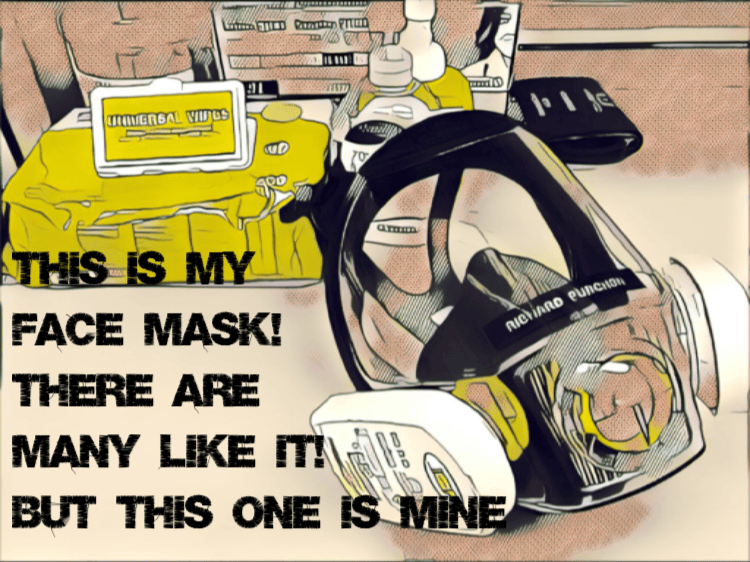
I was issued my own respirator.
Not simply a mask from a box.
My own respirator.
I wrote a will.
There is something curiously clarifying about writing a will because you are going to work.
I did not see my children for more than nine months.
Not because I didn’t want to.
Because I was working around COVID-positive patients and could not accept the possibility of carrying the virus home to them.
Then eventually the statistical risk stopped being theoretical.
I contracted COVID following substantial exposure to a patient.
I received a high viral load.
I became critically ill.
I developed COVID encephalitis.
Instead of working in intensive care, I became one of its patients.
I spent approximately two months there.
I have subsequently been told that I nearly died twice.
I cannot independently describe much of what happened because I remember remarkably little of it. Large parts of that period of my life exist for me only through what other people have subsequently told me.
Eventually I survived.
And eventually I returned to something resembling normal life.
So what did Britain do to recognise people who served through that national emergency?
Well, initially, Britain clapped.
Clap for Carers
I do not criticise the people standing outside their houses.
I think most of them were completely sincere.
People put rainbows in windows.
Children drew pictures.
Neighbours stood in streets.
People banged pans together.
For a frightened population locked inside its homes, it was probably one of the few ways ordinary people felt they could express gratitude towards those continuing to go to work.
There was something genuinely moving about it.
But there is an enormous difference between public gratitude and national recognition.
Applause lasts perhaps a minute.
Recognition lasts a lifetime.
And retrospectively, there is something faintly uncomfortable about congratulating people for accepting an occupational risk that could kill them while many of those applauding were quite properly being instructed to remain safely inside their houses.
Healthcare workers did not need to be called heroes.
Many of us actively disliked it.
Heroes make good newspaper copy.
Professionals require rather less romantic things.
Safe equipment.
Adequate staffing.
Appropriate remuneration.
Support afterwards.
And recognition that what happened was not merely another difficult Tuesday at work.
The George Cross
Britain eventually did something considerably more significant than clapping.
In July 2021, Queen Elizabeth II awarded the George Cross collectively to the National Health Services of the United Kingdom.
The official citation recognised the courage and dedication of healthcare workers during the pandemic and specifically acknowledged that some had died after contracting the virus while doing their work. (GOV.UK)
The George Cross is extraordinary.
It sits at the summit of the British civilian gallantry system alongside the Victoria Cross and is intended to recognise the greatest heroism or conspicuous courage in circumstances of extreme danger. Before the NHS award it had been bestowed collectively only twice: on Malta during the Second World War and on the Royal Ulster Constabulary. (GOV.UK)
I understand why the award was made.
I can understand why many NHS employees were proud of it.
Personally?
It means almost nothing to me.
And I actually think the collective award raises an uncomfortable question about the nature of the George Cross itself.
The distinction is important.
I was not awarded the George Cross.
Neither was the nurse standing next to a ventilator for twelve hours.
Neither was the anaesthetist intubating an infectious patient.
Neither was the ICU consultant.
Neither was the healthcare assistant turning ventilated patients.
Neither was the porter moving bodies to the mortuary.
The institution received it.
The official announcement itself described the award as recognising the NHS’s 73 years of service as well as its response to COVID-19. (GOV.UK)
And therein lies my problem.
Individual experience disappeared into institutional symbolism.
Someone working safely away from COVID patients was encompassed within the same institutional award as someone performing aerosol-generating procedures several inches from an infected airway.
Someone who spent the pandemic working from home belonged to the same organisation.
Someone who wrote a will before returning to intensive care belonged to the same organisation.
Someone who never contracted COVID belonged to the same organisation.
Someone who nearly died from occupational infection belonged to the same organisation.
The George Cross could not possibly distinguish between them because it was never awarded to them individually in the first place.
Perhaps this is unfair.
Perhaps a collective award was the only practical way to recognise an organisation containing more than a million people.
But personally, it felt remarkably like:
“The NHS has received the George Cross. Here’s a photograph of it. Now get back to work.”
And, perhaps:
“Please don’t confuse national gratitude with a discussion about your pay.”
That is satire, obviously.
No government minister actually stood at the doors of an intensive-care unit and said it.
But symbolically, that is increasingly how the period feels to me.
Did We Need a George Cross?
I would have preferred something considerably less grand.
A service medal.
Nothing more.
Nothing pretending that every healthcare worker was displaying conspicuous gallantry.
Nothing equating routine professional service with individual acts deserving Britain’s highest civilian decoration.
Simply:
COVID-19 NATIONAL SERVICE MEDAL
With sensible eligibility criteria.
Perhaps direct clinical care of confirmed or suspected COVID-positive patients.
Perhaps a qualifying period.
Perhaps inclusion of ambulance personnel, care workers and others whose occupations demonstrably required them to accept repeated exposure during the emergency.
Because that would say something the collective George Cross cannot.
You were there.
You served.
No suggestion that you were a hero.
No applause.
No pots and pans.
No rainbow.
Just a small piece of metal permanently recording that, when Britain experienced one of the greatest national emergencies of modern times, you went to work.
Military personnel understand the importance of that distinction instinctively.
Campaign medals are not simply decorations.
They are records.
They become part of a person’s history.
Decades later a child or grandchild can look at that medal and ask:
“What did you do?”
And there is a story attached to it.
COVID healthcare workers have stories too.
Some of them never came home to tell them.
Perhaps We Are Asking the Wrong Question
This is not really an article about medals.
Nor is it fundamentally about immigration.
It is about service.
What happens when an individual accepts an obligation towards their country?
And what reciprocal obligation does that country acquire?
A soldier accepts that he may ultimately be ordered into circumstances where somebody is trying to kill him.
A firefighter accepts danger.
A police officer accepts that violence may become part of an ordinary working day.
During COVID, healthcare professionals suddenly found themselves accepting risks far beyond those normally associated with going to work in a British hospital.
None of those groups should automatically be regarded as superior human beings.
Service is not sainthood.
Nor should service become some grotesque competition over who is most deserving of state assistance.
But neither should it mean nothing.
A country cannot endlessly celebrate service when it requires sacrifice and subsequently rediscover individual responsibility when the person who served needs something in return.
That is the contradiction.
We can stand solemnly at the Cenotaph.
We can applaud from the doorstep.
We can put rainbows in windows.
We can collectively award one of the greatest decorations in the British honours system to an organisation.
But eventually the ceremony ends.
The uniform comes off.
The PPE is thrown away.
The cameras leave.
And the individual remains.
Sometimes that individual is a veteran standing in a council housing office being told that the system cannot help him.
Sometimes it is a healthcare professional dealing with the long-term consequences of a disease acquired while caring for somebody else.
And sometimes they ask an entirely reasonable question:
When I served my country, my country needed me.
Now that I need my country, where exactly is it?
The Grey Men Leave the Room
Perhaps ODPs are partly responsible for our own invisibility.
We were never very good at standing around waiting for applause.
That is not how the profession works.
Something goes wrong.
We appear.
We assess it.
We anticipate.
We get the airway equipment.
We draw up the drugs.
We find another pair of hands.
We solve what can be solved.
And when everybody is safe again, we leave.
No speech.
No medal ceremony.
No expectation of applause.
During COVID, perhaps we did that rather too effectively.
When the country eventually emerged from the emergency, thousands of healthcare professionals simply did what they had always done.
We removed the respirators.
We went back to our departments.
We carried on.
And Britain carried on with us.
Perhaps that is why the question has never really been asked.
Not:
“Were healthcare workers heroes?”
I couldn’t care less.
Ask something much more important.
Did they serve their country?
I believe they did.
And if national service means anything at all, perhaps Britain needs to become considerably better at remembering the people who performed it after everybody has stopped clapping.

